ORCHID CARE
How Much Light Do Orchids Need?
Phalaenopsis orchids grow best with plenty of bright, indirect light. Learn where to place your orchid indoors, how to recognize too much or too little light and when to adjust its location.
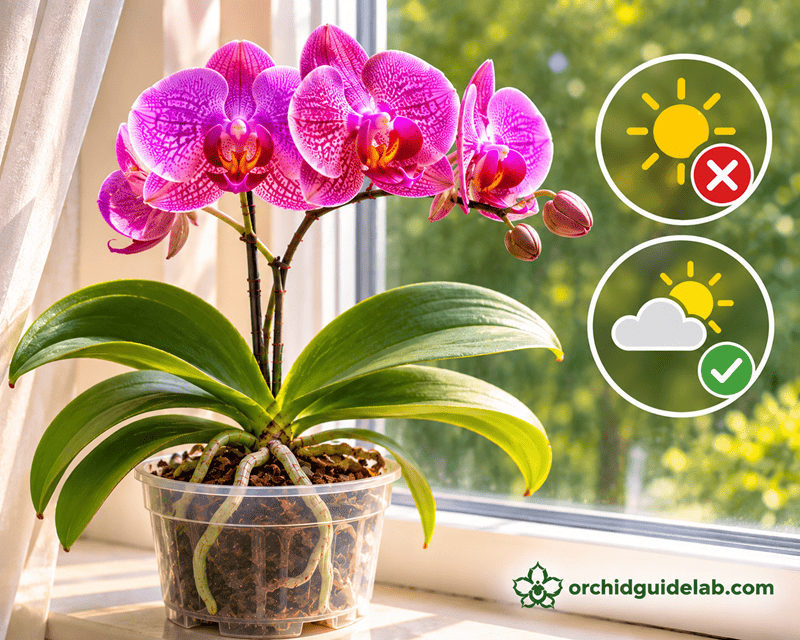
Most Phalaenopsis orchids need bright, indirect light for healthy indoor growth and reliable flowering. They need enough light to support photosynthesis without being exposed to intense direct sun that can overheat or scorch their leaves.
Light indoors varies dramatically depending on window direction, distance from the glass, season, curtains, nearby buildings, trees and local weather.
For this reason, there is no single perfect distance from a window that works in every home. The goal is to provide a bright location and then watch how the orchid responds.
Leaves, growth and flowering can all provide useful clues about whether the plant is receiving an appropriate amount of light.
Orchid light requirements at a glance
- Phalaenopsis orchids prefer bright, indirect light;
- gentle morning sun is usually easier to manage than intense afternoon sun;
- strong direct sunlight can overheat or scorch leaves;
- very low light can reduce growth and flowering;
- distance from the window can dramatically change light intensity;
- sheer curtains can soften strong direct sunlight;
- light conditions change with the seasons;
- artificial grow lights can supplement inadequate natural light.
IDEAL LIGHT
What kind of light do orchids need?
Phalaenopsis orchids are commonly described as low- to medium-light orchids, but this does not mean they thrive in a dark room.
Indoors, they generally perform best in a location that remains comfortably bright for much of the day without exposing the leaves to prolonged, intense direct sunlight.
Bright indirect light can come from a nearby window where sunlight illuminates the area strongly but does not continuously strike the leaves with full intensity.
The orchid should receive enough light to support active leaf and root growth as well as future flower-spike development.
Simple rule: choose a bright indoor location first, then protect the orchid from intense direct sun if the leaves become excessively hot or show signs of light damage.
LIGHT TYPE
Direct vs indirect light for orchids
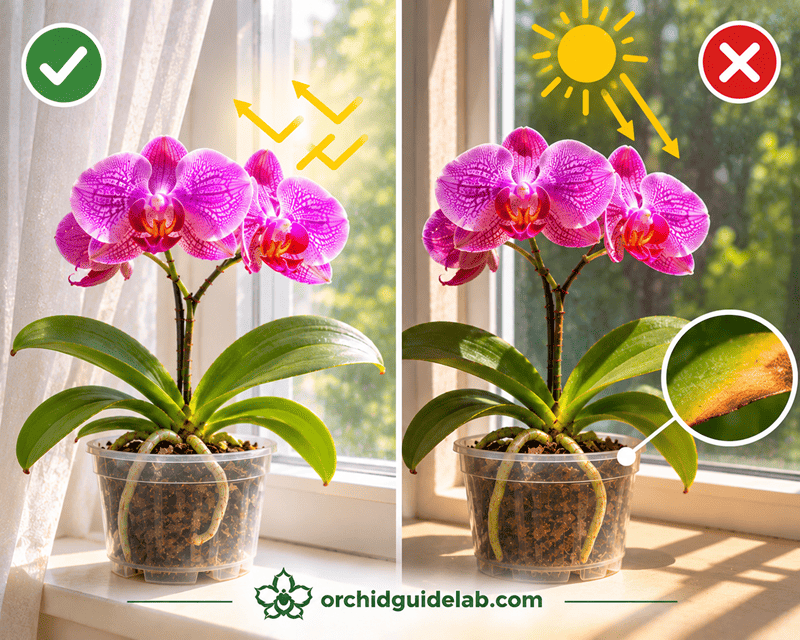
Direct light reaches the plant without being significantly diffused or blocked. On a sunny window, this can create bright, sharply defined patches of sunlight across the orchid's leaves.
Indirect light is softer. The room may still be very bright, but the leaves are not continuously exposed to the strongest rays of the sun.
Phalaenopsis orchids generally tolerate bright indirect light better than hours of intense direct sunlight.
Some gentle direct morning or late-day sun may be acceptable depending on the season, climate and window, but the plant should be monitored for overheating.
PLACEMENT
How close should an orchid be to a window?
There is no universal distance because indoor light depends on much more than the number of inches or feet from the glass.
A plant beside a shaded window may receive less light than an orchid several feet from a large unobstructed window.
Window direction, outdoor shade, curtains, glass coatings, season and latitude can all influence the amount of usable light.
Light also decreases quickly as a plant is moved deeper into a room.
Start with a bright position relatively near a suitable window and adjust the orchid according to the actual conditions and the plant's response.
WINDOWS
Which window gives an orchid the best light?
The best window is one that provides enough brightness without exposing the orchid to damaging heat or prolonged intense sunlight.
An east-facing window is often convenient because it can provide bright light and gentler morning sun.
South- and west-facing windows can provide excellent brightness but may require greater distance from the glass or a sheer curtain when sunlight becomes intense.
North-facing windows may work in bright, unobstructed locations, but some can be too dim for dependable flowering.
The actual brightness of the location matters more than the window label alone.
For a detailed comparison, see Best Window for Orchids .
LIGHT LEVELS
Too little, ideal and too much orchid light
Orchid lighting is easiest to understand as a range rather than a single fixed point.
At one end, a dim location can provide enough light for the plant to survive while still being insufficient for strong growth or dependable flowering.
In the middle is a bright but protected location where the orchid receives substantial light without excessive heat.
At the other end, intense direct sunlight can heat the leaves rapidly and cause permanent tissue damage.

LOW LIGHT
Signs an orchid may not be getting enough light
Orchids can remain alive in locations that are too dim for their best growth. This sometimes makes low-light problems difficult to recognize.
Possible signs of inadequate light include:
- slow or weak overall growth;
- repeated failure to produce a new flower spike;
- very dark green foliage combined with poor flowering;
- long periods with little visible growth despite otherwise reasonable care.
These signs are not exclusive to lighting problems. Root health, temperature, watering and the overall condition of the orchid should also be considered.
If the plant is healthy but consistently fails to flower in a dim location, gradually increasing its light exposure may help.
EXCESS LIGHT
Signs an orchid is getting too much light
Excessive direct sunlight can cause Phalaenopsis leaves to heat up quickly, particularly when the plant is close to window glass.
Warning signs can include:
- leaves that become very warm or hot in direct sun;
- yellowish or unusually pale areas exposed to strong light;
- bleached patches on the leaf surface;
- dry tan or brown areas caused by sun damage;
- sudden localized damage on the side facing the window.
Sunburned tissue does not return to healthy green tissue. The priority is to prevent additional damage.
Move the orchid slightly farther from the window or diffuse intense sunlight with a sheer curtain.
LEAVES
Can leaf color tell you how much light an orchid gets?
Leaf color can provide useful clues, but it should not be used as a precise light meter.
Healthy Phalaenopsis foliage is normally green, although the exact shade varies between plants and hybrids.
Very dark foliage combined with poor flowering can sometimes suggest that the orchid would benefit from more light.
Conversely, foliage that becomes unusually pale or yellowish in a strongly illuminated location may indicate excessive exposure.
Always consider leaf color together with growth, flowering, root condition and the actual lighting environment.
SIMPLE CHECK
Can you use a shadow to judge orchid light?
A simple shadow check can give a rough impression of the character of the light near your orchid.
Hold your hand between the window and the plant during the brightest part of the day.
A very sharp, dark shadow can indicate strong direct light, while a softer shadow suggests more diffused light.
If almost no shadow is visible, the location may be relatively dim.
This is only a quick visual check. It cannot replace actual light measurements because human eyes adapt extremely well to different brightness levels.
MEASUREMENT
Measuring light for orchids
A light meter can be useful when you want to compare several locations in the same home.
Measurements should be taken where the orchid's leaves actually sit, not directly against the window if the plant grows farther away.
Light changes throughout the day, so a single measurement does not describe the entire daily exposure.
Measurements on sunny and cloudy days can also differ substantially.
The most useful approach is to combine measurements with observations of the plant over time.
SEASONS
Orchid light changes with the seasons
A window that works perfectly during one season can provide very different conditions several months later.
The sun's angle and the length of the day change throughout the year. Outdoor trees can also shade a window in summer and leave it exposed after their leaves fall.
Winter can bring much lower overall light levels, while summer sunlight can become considerably stronger and hotter near the glass.
Reevaluate your orchid's position when seasonal conditions change rather than assuming one location will always provide identical light.
DIFFUSING SUN
Using sheer curtains for orchid light
A sheer curtain is a simple way to reduce the intensity of strong direct sunlight while keeping the area relatively bright.
This can be especially useful at windows that receive strong midday or afternoon sun.
The curtain should diffuse the light rather than make the growing area unnecessarily dark.
You can also move the orchid farther from the window if the leaves become too warm.
ARTIFICIAL LIGHT
Can orchids grow under artificial light?
Yes. Artificial grow lights can supplement natural light or provide the primary light source when a room is too dim.
This can be useful in apartments with limited window space, during dark winters or when orchids are displayed away from windows.
The effectiveness of a grow light depends on its output, distance from the leaves and daily operating time.
A weak light placed too far away may provide little useful illumination, while a powerful fixture placed too close can cause excessive light or heat.
Adjust the setup according to the manufacturer's specifications and the orchid's response.

FLOWERING
Does an orchid need more light to rebloom?
Adequate light is an important part of supporting future flowering.
An otherwise healthy Phalaenopsis kept in a consistently dim location may grow leaves but fail to produce a new flower spike reliably.
If root health, watering and general care appear appropriate but the orchid repeatedly fails to rebloom, evaluate whether its location is bright enough.
Increase light gradually rather than moving a shade-acclimated plant directly into intense sunlight.
For more flowering guidance, see How to Get an Orchid to Rebloom .
ADJUSTMENT
Increase orchid light gradually
Orchids adapt to the light conditions in which they have been growing.
A plant that has spent months in a dim location can be more vulnerable to sudden exposure to intense sunlight.
When moving an orchid to a brighter location, increase its exposure gradually and monitor the leaves.
This is particularly important when moving the plant closer to a sunny window or changing its location seasonally.
PLANT POSITION
Should you rotate an orchid toward the light?
Phalaenopsis leaves and flower spikes naturally orient themselves toward available light.
Occasional rotation during vegetative growth can help keep the plant's growth more balanced if light comes strongly from one direction.
However, frequent rotation is not necessary.
Once a flower spike is developing, maintaining a relatively consistent orientation can help the spike and buds develop in a predictable direction.

QUICK CHECK
Orchid light checklist
Choose a bright indoor location.
Favor bright indirect light over intense prolonged direct sun.
Watch for hot leaves, bleaching or sunburn near strong windows.
Reevaluate the location as seasons change.
Consider a grow light if natural light is inadequate.
Best Window for Orchids →COMMON MISTAKES
Common orchid lighting mistakes
- Keeping an orchid in a dark room. Surviving in low light is not the same as receiving enough light for strong growth and flowering.
- Placing the plant immediately in intense sun. Sudden exposure can damage leaves that are adapted to lower light.
- Ignoring leaf temperature. Strong sunlight through glass can heat foliage even when the room feels comfortable.
- Relying only on window direction. Outdoor shade and distance from the glass can change actual light dramatically.
- Never changing the orchid's position. Seasonal changes can turn a suitable location into one that is too dim or too intense.
- Using leaf color as the only indicator. Consider growth, flowering and overall plant health as well.
- Putting a grow light too far away. Artificial light must reach the leaves at a useful intensity.
FINAL ADVICE
Give your orchid bright light without harsh sun
For most indoor Phalaenopsis orchids, bright indirect light provides the best starting point.
Place the plant near a bright window where it receives substantial daylight, but protect the leaves from prolonged, intense sunlight that causes overheating or scorching.
If the orchid grows slowly and repeatedly fails to flower despite otherwise good care, evaluate whether its location may be too dim.
If the leaves become hot, bleached or develop dry sunburned patches, reduce the intensity of direct sunlight.
Remember that indoor light changes with window direction, distance, outdoor shade and season. Observe the plant and adjust its position when conditions change.
The goal is not the brightest possible location. It is a consistently bright environment that supports healthy growth without damaging the foliage.
READ NEXT
More orchid care guides
Best Window for Orchids
Compare window directions and choose the best indoor position.
Phalaenopsis Orchid Care
Learn the essential care requirements for indoor Phalaenopsis orchids.
How to Care for an Orchid Indoors
Build a healthy indoor environment for your orchid.
How to Get an Orchid to Rebloom
Support new flower-spike development and future blooms.
Orchid Temperature Requirements
Learn how indoor temperatures affect orchid growth and flowering.
Winter Orchid Care
Adjust light, watering and placement during the darker winter months.