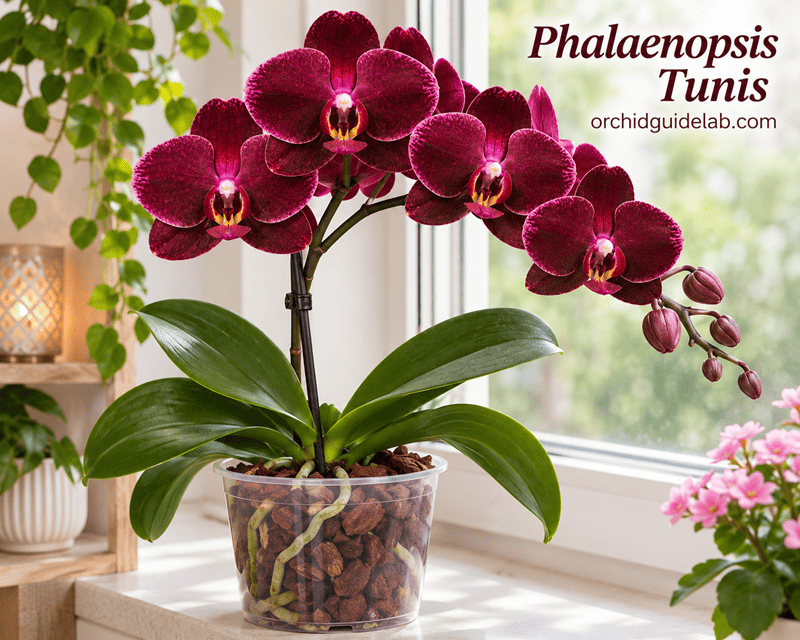
Phalaenopsis Tunis Flower Description
The most distinctive feature of Phalaenopsis Tunis is its deep, dark burgundy coloring. The broad, rounded side petals display rich wine-red and purple shades. Their fine surface texture gives the flowers an almost velvety appearance.
The upper sepal has a particularly dark burgundy tone, while the lower sepals complement the flower's overall rich color. Subtle lighter transitions near the petal edges emphasize their smooth, rounded shape.
The center is especially eye-catching. The lip combines burgundy, yellow and orange details, while the pale column stands out against the darker petals. In soft daylight, the flowers reveal beautiful variations of wine-red and purple.
Key Characteristics
| Name | Phalaenopsis Tunis |
|---|---|
| Genus | Phalaenopsis |
| Family | Orchidaceae |
| Category | Ornamental Phalaenopsis orchid |
| Main Flower Color | Dark burgundy with purple undertones |
| Flower Pattern | Rich, nearly solid coloring with subtle tonal variations |
| Flower Shape | Rounded, with broad lateral petals |
| Lip | Burgundy with yellow and orange details |
| Light | Bright indirect light |
| Watering | After the bark has dried sufficiently |
| Potting Medium | Well-aerated orchid bark |
What Makes Phalaenopsis Tunis Special?
Tunis stands out because of its unusually deep flower color. In a dimly lit room, the blooms may appear almost black. Under brighter, indirect light, their burgundy and purple undertones become much easier to appreciate.
Unlike Phalaenopsis orchids with large spots or contrasting stripes, Tunis attracts attention mainly through the intense coloring of its entire flower. The bright central lip adds another layer of contrast and visual interest.
This orchid looks particularly elegant on a bright windowsill, where its dark flowers create a striking accent against green leaves and lighter houseplants.
How to Care for Phalaenopsis Tunis at Home
Phalaenopsis Tunis can be cared for using the same general principles as other commonly grown Phalaenopsis orchids. The essentials are sufficient indirect light, careful watering and good airflow around the roots.
Lighting
Place the orchid near a bright window where it receives plenty of indirect daylight. An east-facing window is often a convenient choice. If the plant is kept near a south-facing window, protect it from intense midday sunlight to prevent leaf damage.
Watering
Water Tunis when the bark has dried sufficiently. Avoid following a fixed watering schedule without checking the potting medium. Bark dries more slowly in a cool room than in a warm, bright environment.
Practical tip: A transparent orchid pot with drainage holes makes it easier to observe root condition and moisture inside the bark. Always allow excess water to drain completely after watering.
Temperature and Humidity
Keep the orchid at a comfortable indoor temperature and avoid cold drafts or sudden temperature changes. Do not place the pot directly next to a hot radiator. Moderate humidity and gentle air circulation help support healthy growth.
Potting Medium and Fertilizer
Use a suitable orchid bark mix that allows air to reach the roots. Dense ordinary potting soil is unsuitable because it can retain too much moisture and restrict root ventilation.
During active growth, a fertilizer formulated for orchids may be used according to the manufacturer's instructions. Avoid excessive feeding.
Care During and After Flowering
During flowering, try to maintain stable growing conditions. Avoid moving the orchid unnecessarily, especially between locations with very different light or temperature levels.
If a flower spike bends under the weight of the blooms, it can be gently secured to a suitable support.
After the flowers fade, continue normal care. A completely dry flower spike can be removed using a clean cutting tool. If the spike remains green, immediate pruning is not always necessary.
When Should You Repot Tunis?
Repot the orchid when the bark begins to break down, becomes compacted or retains moisture for too long.
If the roots are healthy and the potting medium remains airy, there is usually no need to repot immediately after purchase.
Phalaenopsis Tunis Photo Gallery
The rich burgundy petals and bright central details make Phalaenopsis Tunis especially photogenic. Select any image below to view it at a larger size.

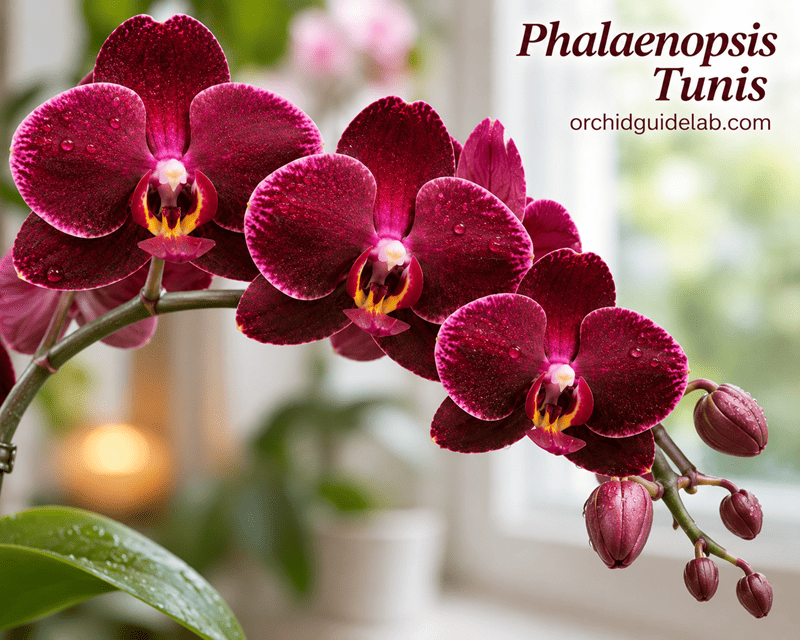


These images were created using artificial intelligence to reflect the original appearance of the plant.
Frequently Asked Questions
What color are Phalaenopsis Tunis flowers?
The flowers are deep burgundy with purple undertones. Their central lip combines burgundy, yellow and orange details.
Is Phalaenopsis Tunis a black orchid?
No. Its flowers are very dark burgundy-purple and may appear almost black in low light. In good lighting, their rich wine-colored tones become visible.
How often should I water Phalaenopsis Tunis?
Water when the bark has dried sufficiently. The interval depends on temperature, humidity, pot size and the condition of the potting medium.
Where should I place Phalaenopsis Tunis?
Choose a bright location with indirect light. Protect the orchid from prolonged exposure to strong midday sun.