ORCHID PEST CONTROL
Spider Mites on Orchids: Signs, Treatment & Prevention
Tiny pale dots, silvery leaf damage or delicate webbing may indicate spider mites on your orchid. These microscopic relatives of spiders feed on plant cells and can damage Phalaenopsis leaves before you notice the pests themselves. Learn how to identify an infestation, choose appropriate treatment and prevent spider mites from returning.
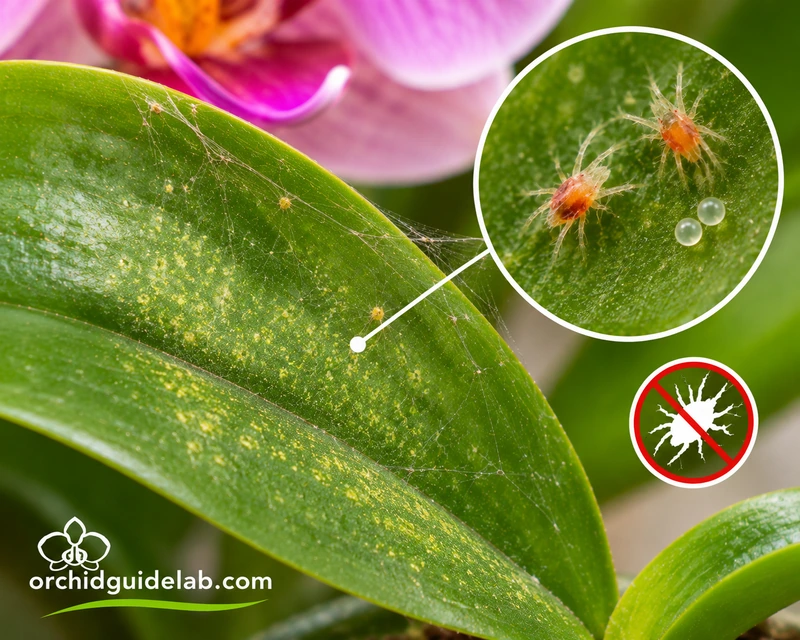
Spider mites on orchids are tiny, sap-feeding arachnids that damage leaf cells and may cause pale stippling, discoloration or fine webbing. They often remain unnoticed until visible leaf damage develops.
Spider mites are not true insects. They belong to the mite group and are related to spiders and ticks. Many common plant-feeding species have eight legs as adults.
These pests can affect Phalaenopsis and other orchids, particularly when infestations spread through an indoor plant collection.
Quick answer: how to get rid of spider mites on orchids
- Isolate the affected orchid from other plants.
- Inspect both sides of every leaf with a magnifier.
- Look for moving dots, stippling and possible webbing.
- Gently wipe accessible leaves with a damp, soft cloth.
- Use a gentle water rinse when suitable for the plant.
- Keep water out of the crown and leaf joints.
- Consider a product specifically labeled for spider mites if needed.
- Follow all application and repeat-treatment instructions.
- Inspect neighboring houseplants.
- Monitor for several weeks after visible mites disappear.
Early identification is especially important because old feeding damage usually remains visible even after the mites have been controlled.
PEST IDENTIFICATION
What are spider mites on orchids?
Spider mites are extremely small plant-feeding mites. Depending on the species, they may appear greenish, yellowish, reddish or nearly translucent.
Some common spider mites, including the two-spotted spider mite, produce fine silk webbing when populations become established.
Other mites that affect orchids, including certain flat mites, may produce little or no webbing.
How small are spider mites?
Many adult spider mites measure roughly half a millimeter or less, making them difficult to identify without magnification.
On a dark green orchid leaf, they may look like tiny moving specks.
Where do spider mites hide?
- on the undersides of leaves;
- along the central leaf vein;
- near leaf edges;
- around sheltered leaf joints;
- on young growth and other accessible tissues.
Identification tip: Hold a sheet of white paper beneath a suspect leaf and gently tap the leaf. Tiny moving specks on the paper may indicate mites. Confirm with a magnifier because dust and other small organisms can look similar.
EARLY WARNING SIGNS
Signs of spider mites on orchid leaves
The first visible sign is often leaf discoloration rather than the mites themselves.
1. Tiny pale or yellow dots
Feeding damages individual leaf cells, creating small light-colored spots known as stippling.
Numerous feeding spots can merge into larger pale areas.
2. Silvery or bronze leaf surfaces
As damage increases, affected leaves may develop a dull, silvery, yellowish or bronze appearance.
3. Fine webbing
Certain spider mite species produce thin silk threads along leaves and other plant surfaces.
Webbing may be easier to notice when the infestation becomes heavy.
4. Tiny moving dots
Close inspection may reveal extremely small mites moving across the undersides of leaves.
5. Dry or damaged leaf patches
Severe feeding may result in larger discolored areas and reduced leaf function.
6. Reduced plant vigor
Persistent infestations can weaken the orchid and interfere with healthy growth.

DIAGNOSIS
Spider mite damage vs. other orchid leaf problems
Not every yellow, silver or damaged patch on an orchid is caused by mites.
Sunburn, mechanical injury, mineral residue and other pests may produce symptoms that appear similar at first glance.
| Problem | Typical appearance | Useful clue |
|---|---|---|
| Spider mites | Fine pale stippling, sometimes bronzing or webbing | Tiny mites visible with magnification |
| Sunburn | Larger bleached, yellow or brown damaged areas | Often on surfaces exposed to intense light |
| Mineral residue | White or chalky surface marks | Deposits remain on the surface rather than inside leaf tissue |
| Thrips | Silvery scarring and possible dark fecal spots | Slender insects may be visible on leaves or flowers |
| Natural aging | Gradual yellowing of an older leaf | No mites or characteristic fine feeding stippling |

If the damaged area appeared after strong sunlight exposure, read Orchid Leaf Sunburn .
For general yellowing symptoms, see Why Are My Orchid Leaves Turning Yellow? .
HOW INFESTATIONS BEGIN
What causes spider mites on orchids?
Spider mites are introduced from existing populations, often through new plants or contact with infested neighboring vegetation.
Warm, dry conditions can favor the rapid development of some common spider mite species.
Newly purchased orchids
Small mite populations may remain unnoticed when a new orchid is brought home.
Nearby houseplants
Many spider mites feed on a wide range of plants. An infestation may spread between neighboring pots.
Warm indoor conditions
Some species reproduce quickly under favorable temperatures, allowing populations to increase before they are detected.
Dry air
Low humidity may favor certain spider mites, although humidity alone does not determine whether an infestation occurs.
Delayed detection
Because mites are so small, damage can become noticeable before the pests are identified.
Important: Spider mites do not appear spontaneously because an orchid was watered incorrectly. An infestation requires the presence of mites.
PLANT HEALTH
Are spider mites dangerous to orchids?
Yes. Spider mites feed by damaging plant cells, reducing the quality and function of affected leaf tissue.
A small infestation may cause limited cosmetic damage.
A heavy infestation can lead to widespread discoloration, weakened growth and serious stress.
Can spider mites kill an orchid?
Severe, prolonged infestations may contribute to the decline or death of a vulnerable orchid.
However, early identification and effective control greatly improve the chance of recovery.
Will damaged orchid leaves turn green again?
Areas where leaf cells have been permanently damaged usually do not regain their original appearance.
The goal of treatment is to stop further feeding and protect healthy new growth.
STEP-BY-STEP TREATMENT
How to get rid of spider mites on orchids
Spider mite management requires accurate identification, careful cleaning and repeated monitoring.
Step 1. Isolate the orchid
Move the affected plant away from other orchids and houseplants.
Step 2. Confirm the infestation
Examine the undersides of leaves with a magnifying glass. Look for moving mites, eggs and characteristic feeding damage.
Step 3. Remove accessible mites
Gently wipe leaves with a soft cloth moistened with clean water.
Support the leaf while cleaning to avoid bending or tearing it.
Step 4. Consider a gentle water rinse
A controlled, gentle stream of water can dislodge some exposed mites.
Avoid strong water pressure and prevent water from remaining in the orchid's crown or leaf joints.
Step 5. Inspect nearby plants
Check neighboring orchids and other houseplants for stippling, moving mites or webbing.
Step 6. Use an appropriate product if necessary
For persistent infestations, choose a miticide or other pest-control product specifically labeled for spider mites and suitable for orchids or ornamental plants.
Some insecticidal soaps and horticultural oils may be labeled for spider mite control.
Follow all label instructions for dilution, application, plant safety and repeat treatments.
Step 7. Monitor new activity
Inspect the orchid regularly because eggs and hidden mites may survive the initial cleaning.
Step 8. Continue isolation
Keep the orchid separate until repeated inspections show no ongoing mite activity.

TREATMENT OPTIONS
Does insecticidal soap kill spider mites on orchids?
Some formulated insecticidal soaps are labeled for spider mite control.
These products generally work through direct contact with exposed pests rather than providing long-lasting protection.
Because mites often live on leaf undersides, thorough coverage according to the product label is important.
Precautions for orchids
- confirm the product is suitable for the plant and pest;
- follow label dilution and application directions;
- test a small area when recommended;
- avoid treatment during intense sunlight or excessive heat;
- protect sensitive flowers and buds;
- watch for spotting, discoloration or other plant injury.
Do not substitute ordinary dishwashing detergent for a formulated insecticidal soap.
Can neem oil control spider mites on orchids?
Certain neem-based and other horticultural oil products may be labeled for spider mite management.
Their suitability depends on the specific formulation, the orchid and the application conditions.
Oils may damage sensitive plant tissues when used incorrectly.
Always follow the product label and avoid combining products unless explicitly permitted.
SAFE HOME CARE
Home remedies for spider mites on orchids: what works?
Simple physical cleaning can help reduce exposed mite populations, particularly when an infestation is discovered early.
Gentle leaf wiping
A soft, damp cloth can remove some mites and surface debris.
Avoid rough scrubbing, especially on thin or tender leaves.
Careful water rinsing
A gentle rinse can dislodge exposed mites, but it may not remove every egg or hidden individual.
Does increasing humidity help?
Some common spider mites reproduce especially well in warm, dry environments.
Maintaining humidity appropriate for your orchid may support plant health, but raising humidity alone is not a reliable cure for an active infestation.
Avoid keeping leaves constantly wet or reducing airflow to the point that fungal and bacterial problems develop.
Should you use rubbing alcohol?
Alcohol can damage sensitive orchid tissues and is not a preferred routine whole-plant treatment for spider mites.
Avoid soaking or spraying the orchid with homemade alcohol mixtures.
FOLLOW-UP CONTROL
How often should you treat spider mites on orchids?
Spider mites can develop quickly under favorable conditions.
Eggs may remain after adult mites have been removed, making follow-up inspections essential.
Check the orchid every few days during the initial control period.
If using a pesticide or miticide, repeat applications only at the intervals specified on the product label.
Why spider mites return
- eggs survived the first treatment;
- mites remained hidden on leaf undersides;
- neighboring plants were not inspected;
- the treatment did not contact enough mites;
- the orchid was returned to an infested area too soon.
Continue monitoring for several weeks after the last visible mite has disappeared.
COMMON QUESTIONS
Do spider mites always make webs on orchids?
No. Fine webbing is a useful warning sign for certain spider mite species, but it is not present in every infestation.
Some infestations are detected through leaf stippling long before webbing becomes obvious.
Other orchid-feeding mites may not produce visible silk webs.
What if there is damage but no webbing?
Examine the undersides of leaves with a magnifier.
Look for tiny moving mites and eggs rather than relying on webbing alone.
Could it be an ordinary spider?
Ordinary spiders are predators, not plant-feeding mites.
A spider web near an orchid does not automatically indicate spider mite damage.
LONG-TERM PREVENTION
How to prevent spider mites on orchids
Prevention begins with regular inspection and careful management of newly introduced plants.
Inspect new orchids before purchase
Check both sides of the leaves for stippling, discoloration, moving mites or fine webbing.
Observe new plants separately
A temporary isolation period can help reveal pests that were initially difficult to detect.
Inspect leaf undersides regularly
Spider mites often remain on surfaces that are overlooked during routine watering.
Avoid excessive heat and dryness
Maintain growing conditions appropriate for the orchid and avoid placing plants directly beside hot, drying airflows.
Maintain appropriate humidity and airflow
Balanced humidity and ventilation support orchid health without creating persistently wet leaf surfaces.
Inspect neighboring houseplants
Spider mites can affect many different ornamental plants.
Keep leaves accessible for inspection
Avoid overcrowding orchids so that both sides of the leaves can be checked.
Act quickly when mites appear
Early intervention helps limit feeding damage and reduces the risk of spread.

PREVENTION CHECKLIST
Keep your orchids protected
- Inspect new orchids before purchase.
- Observe new plants separately.
- Check leaf undersides regularly.
- Watch for tiny pale feeding spots.
- Use magnification when needed.
- Inspect neighboring houseplants.
- Maintain suitable humidity and airflow.
- Avoid excessive heat and dryness.
- Follow treatment labels carefully.
- Continue monitoring after control.
AVOID THESE ERRORS
Common mistakes when treating spider mites on orchids
- Waiting for visible webbing. Some infestations cause leaf damage before webs become noticeable.
- Ignoring leaf undersides. Mites often hide on surfaces that are difficult to see.
- Using the wrong pesticide. Not every insecticide is effective against mites.
- Applying excessive chemicals. Incorrect treatment can damage sensitive orchid tissues.
- Using household detergents. Ordinary dish soap is not equivalent to a formulated insecticidal soap.
- Leaving water in the crown. Persistent moisture around the growing point can contribute to rot.
- Stopping inspections too early. Eggs or hidden mites may remain.
- Ignoring nearby plants. Untreated host plants may allow reinfestation.
For information about moisture collecting in the growing point, see Orchid Crown Rot .
AFTER TREATMENT
How to help an orchid recover from spider mite damage
After controlling the infestation, maintain stable growing conditions and avoid additional plant stress.
Do not remove every discolored leaf automatically. A damaged leaf may still contribute to the plant's overall health.
Signs of successful recovery
- no live mites during repeated inspections;
- no new feeding spots on healthy tissue;
- no fresh webbing from web-producing species;
- stable leaf condition;
- healthy new roots or leaves;
- improved overall plant vigor.
Existing pale spots and scarred areas may remain visible after the infestation has ended.
Healthy new growth is a better indicator of long-term recovery.
If your orchid remains severely stressed, read How to Revive a Dying Orchid .
FREQUENT QUESTIONS
Frequently asked questions about spider mites on orchids
What do spider mites look like on orchids?
Spider mites are extremely small, often appearing as moving dots on the undersides of leaves. Some are reddish, greenish or pale. Their feeding may cause fine yellow or silvery stippling, and certain species produce delicate webbing.
How do I get rid of spider mites on orchids?
Isolate the orchid, confirm mites are present, gently clean accessible leaf surfaces and monitor closely. For persistent infestations, use a product specifically labeled for spider mites and suitable for orchids or ornamental plants, following all directions.
Do spider mites always make webs on orchids?
No. Fine webbing is associated with some spider mite species and may become more visible during heavier infestations. Early infestations and certain mite species may show little or no obvious webbing.
Can spider mites kill an orchid?
Severe, prolonged spider mite feeding can weaken an orchid and contribute to serious decline, especially when the plant is already stressed. Early detection and appropriate treatment improve the chances of recovery.
How long does it take to eliminate spider mites on orchids?
Control often requires several weeks of monitoring and repeated label-directed treatment because eggs and hidden mites may survive an initial cleaning. The exact schedule depends on the mite species and treatment used.
KEY TAKEAWAY
Protect your orchids by detecting spider mites early
Spider mites can damage orchid leaves before they become easy to see.
Tiny pale feeding spots, unusual discoloration and occasional webbing are important warning signs.
Confirm the pests with magnification, isolate affected plants and clean accessible surfaces gently.
For persistent infestations, choose a suitable labeled treatment and follow its instructions carefully.
With early action, consistent monitoring and suitable growing conditions, many orchids can recover from spider mite infestations and continue producing healthy new growth.
READ NEXT
Related guides
Mealybugs on Orchids
Identify white cottony pests and learn how to control them.
Orchid Leaf Sunburn
Recognize damage caused by excessive light exposure.
Why Are My Orchid Leaves Turning Yellow?
Understand common causes of yellowing and leaf stress.
Brown Spots on Orchid Leaves
Compare possible causes of leaf spots and damage.
Orchid Crown Rot
Learn how trapped moisture can threaten the growing point.
How to Revive a Dying Orchid
Practical steps for diagnosing and supporting a struggling orchid.