ORCHID CARE
Best Pots for Orchids
The best orchid pot supports the roots without surrounding them with excess medium. Good drainage, ventilation and the right size can make Phalaenopsis care much easier.
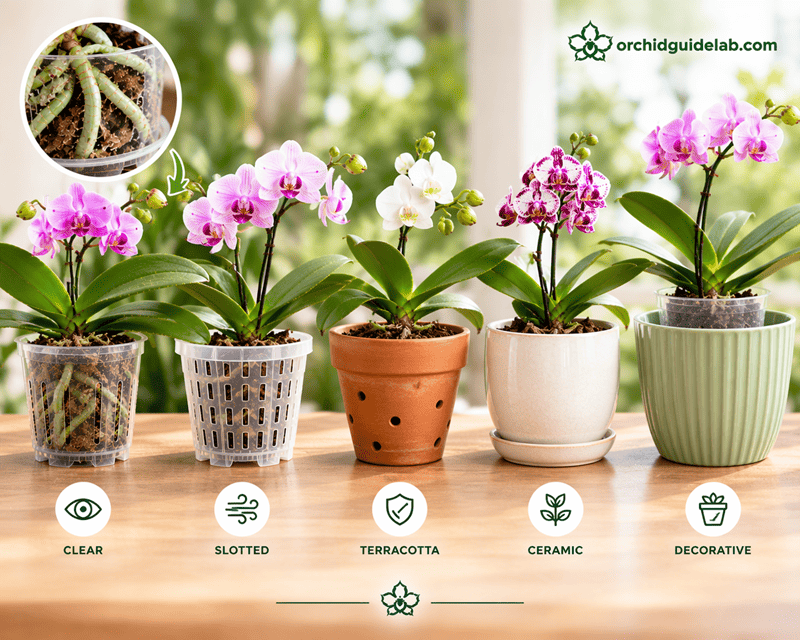
For many indoor Phalaenopsis orchids, a clear plastic pot with generous drainage and ventilation is one of the most practical choices because it allows you to monitor roots and moisture while supporting efficient drying.
Orchid pots do more than hold a plant upright. The container affects how quickly potting material dries, how much air reaches the roots and how easily excess water can escape.
Pot size matters just as much as material. An oversized container can hold more wet medium around the root system than the plant needs, while a pot that is too small may crowd healthy roots unnecessarily.
The best choice combines an appropriate size, effective drainage, useful ventilation and a potting medium suited to your environment.
What makes a good orchid pot?
- multiple drainage holes for excess water;
- ventilation that allows air around the root zone;
- a size reasonably matched to the root system;
- enough stability to support the plant;
- easy access for watering and repotting;
- root visibility when using a transparent pot.
WHY THE POT MATTERS
Why orchid pots are different from ordinary plant pots
Many Phalaenopsis orchids are epiphytes. Their roots are adapted to environments where they receive both moisture and air.
A dense root environment that stays saturated for long periods can therefore be difficult to manage successfully.
Orchid pots are often designed with more drainage and ventilation than conventional houseplant containers.
Combined with an open potting medium such as orchid bark, these openings help water drain and allow the root zone to move through a healthier wet-to-drier cycle.
Key principle: choose the pot and potting medium together. The same bark or sphagnum moss can dry very differently in two different containers.
CLEAR POTS
Are clear pots good for orchids?
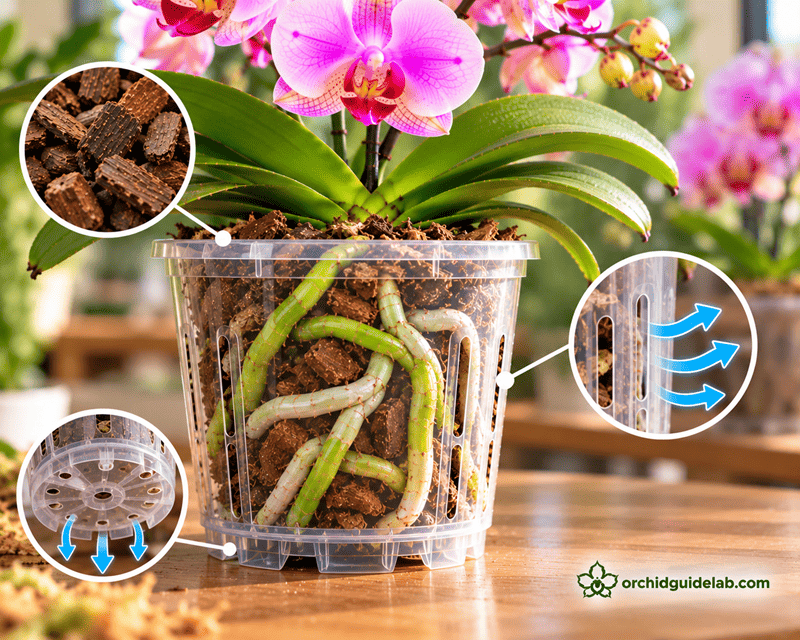
Clear plastic pots are especially useful for Phalaenopsis orchids because they make the root system visible without removing the plant from its container.
You can observe root condition, moisture inside the pot and the state of bark or sphagnum moss.
This can make watering decisions easier. Instead of relying only on a schedule, you can combine root appearance with the actual moisture visible through the sides of the pot.
Transparent plastic is also lightweight and makes it easy to add multiple drainage and ventilation openings.
For more detail, see: Clear Pots for Orchids .
VENTILATION
Are slotted orchid pots better?
Side slots and additional holes can increase air exchange through the potting medium and allow more routes for excess water to leave.
This can be especially helpful when using bark or another open medium.
A highly ventilated pot generally dries faster than a container with only a few drainage holes.
That difference can be beneficial in humid conditions or for growers who tend to water frequently.
In very dry environments, however, an extremely ventilated pot may dry faster than desired. Pot design should therefore match both the medium and your growing conditions.

POT SIZE
What size pot does an orchid need?
An orchid pot should be selected primarily according to the size of the healthy root system, not the height of the leaves or the number of flowers.
Phalaenopsis orchids often grow well in containers that look relatively compact compared with the plant above them.
The roots should fit comfortably without being crushed, but there should not be a large volume of unused potting medium surrounding them.
Too much medium can remain wet longer, especially in the center of the pot.
When repotting, moving up dramatically in pot size is usually unnecessary unless the healthy root system genuinely requires the extra space.
SIZE COMPARISON
Small vs oversized orchid pots
A correctly sized pot holds the root system securely with enough room for fresh medium.
An oversized pot contains a larger mass of bark or moss, which can change how slowly the center of the container dries.
A pot that is unnecessarily small can make repotting difficult and may force healthy roots into an excessively tight space.
The goal is not the smallest possible pot or the largest available pot. It is a container appropriately matched to the roots.
PLASTIC POTS
Plastic pots for orchids
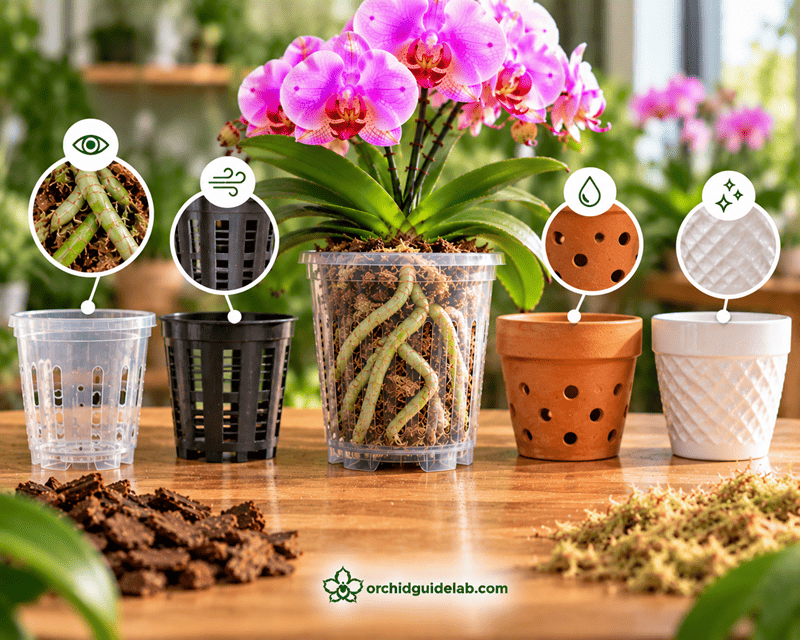
Plastic orchid pots are lightweight, practical and widely used for indoor Phalaenopsis orchids.
Clear plastic offers the additional advantage of root visibility. It is also easy for manufacturers to create numerous drainage and ventilation openings.
Plastic itself does not absorb water, so moisture leaves primarily through drainage, evaporation from the medium and ventilation openings.
This can make moisture behavior relatively easy to observe in a transparent pot.
CERAMIC POTS
Ceramic pots for orchids
Ceramic orchid pots can provide more weight and stability than lightweight plastic containers.
This can be useful for a large plant with heavy leaves or tall flower spikes.
The most important feature is still effective drainage. A decorative ceramic container with no drainage should not allow the orchid's inner pot to remain standing in collected water.
One practical approach is to grow the orchid in a clear ventilated inner pot and place that pot inside a decorative outer container.
The inner pot can then be removed for watering and allowed to drain before it is returned to the cachepot.
TERRACOTTA
Are terracotta pots good for orchids?
Unglazed terracotta is porous and can allow moisture to evaporate through the walls of the pot.
This can help a potting medium dry faster than it would in nonporous plastic.
Terracotta also provides useful weight, making the plant less likely to tip over.
The tradeoff is that orchid roots can attach strongly to porous surfaces. This can make later repotting more difficult and increase the risk of root damage when the plant is removed.
Because terracotta can dry faster, watering frequency may also need to be adjusted.
DECORATIVE POTS
Can an orchid stay inside a decorative pot?
Yes, but the decorative container should not trap water around the orchid's growing pot.
Many Phalaenopsis orchids are sold in clear plastic pots placed inside decorative cachepots.
This arrangement can work well if the inner pot is removed during watering and allowed to drain completely.
Before returning the plant, empty any water that has collected inside the decorative container.
Important: drainage holes in the inner pot are not useful if that pot remains submerged in water trapped inside an outer container.
POT + BARK
Best pots for orchids growing in bark
Chunky orchid bark naturally creates relatively large air spaces between particles.
Combining bark with a clear ventilated pot creates an especially open root environment.
This setup can work well for many mature Phalaenopsis orchids, but it may dry quickly in warm or low-humidity conditions.
If your bark dries too fast, you may need to adjust watering, bark size or pot ventilation rather than simply increasing the size of the container.
See: Best Orchid Bark .
POT + MOSS
Best pots for orchids growing in sphagnum moss
Sphagnum moss retains substantially more moisture than coarse bark.
Good drainage and useful ventilation therefore become especially important when an orchid is grown in moss.
A clear pot also makes it easier to inspect moisture deeper inside the sphagnum rather than judging only the dry-looking surface.
Avoid combining tightly packed moss, an oversized container and poor ventilation. Together, these factors can produce a root zone that dries very slowly.
Read: Sphagnum Moss for Orchids .
DRAINAGE
How many drainage holes does an orchid pot need?
There is no single correct number of drainage holes for every orchid pot. Their effectiveness depends on the size and design of the container.
The important requirement is that water can leave the pot freely instead of collecting around the roots.
Multiple openings across the bottom generally provide more reliable drainage than one small hole.
Side slots can add ventilation and create additional pathways for air movement.
After watering, allow the container to drain before placing it back on a saucer or inside a decorative pot.
ROOT HEALTH
Let the orchid roots guide your pot choice
Healthy roots are more important than matching the pot to the size of the leaves or flowers.
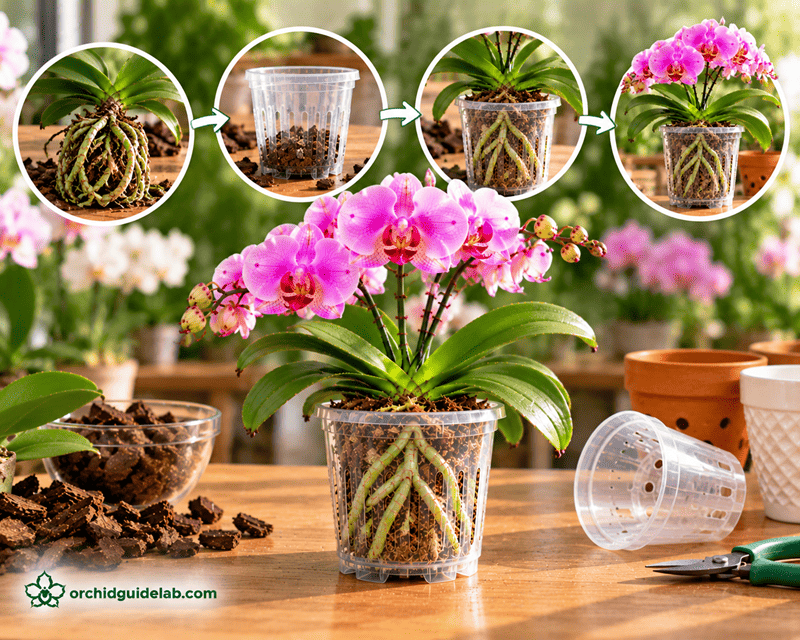
When repotting, inspect the root system first. Remove old medium and determine how much healthy root mass actually needs to fit inside the new pot.
If damaged roots are removed, the orchid may need the same pot size or even a smaller container rather than a larger one.
This is why pot size should be chosen after the roots are evaluated, not before.
Learn more: Orchid Root Care .
REPOTTING
Choosing a pot when repotting an orchid
Repotting is the best time to evaluate whether the current container still matches the root system.
Remove the orchid carefully, clean away old medium and inspect the roots.
Select a pot that accommodates the remaining healthy roots without requiring them to be crushed or surrounded by excessive empty space.
Add fresh potting medium around the roots while keeping the crown of the orchid above the medium.
Full guide: How to Repot an Orchid .
POT CHANGE
When does an orchid need a larger pot?
An orchid may need a larger pot when a healthy, expanding root system can no longer fit comfortably into the current container.
A few roots growing outside the pot do not automatically mean that the orchid needs more space.
Phalaenopsis commonly produce aerial roots, and these roots do not all need to be forced inside a container.
Increase pot size only as much as necessary to accommodate the healthy root system.
If the medium is decomposed but the root mass still fits well, you may simply replace the medium and reuse the same size pot.
QUICK CHECK
Best orchid pot checklist
Choose a pot with reliable bottom drainage.
Use side ventilation when additional airflow is useful for your medium.
Match the pot size to the healthy root system.
Consider a clear pot if you want to monitor roots and moisture easily.
Never allow an inner orchid pot to remain standing in water inside a decorative container.
Choose the Right Pot Size →COMMON MISTAKES
Common orchid pot mistakes
- Choosing a pot that is much too large. Excess medium around a small root system can stay wet longer than expected.
- Using a container without adequate drainage. Excess water needs a reliable way to leave the root zone.
- Leaving water inside a cachepot. Always empty collected water after the inner pot drains.
- Choosing pot size by leaf size. The healthy root system is a better guide.
- Forcing every aerial root into the pot. Aerial roots are normal and do not all need to be buried.
- Ignoring the potting medium. Bark and sphagnum moss behave differently in the same container.
- Assuming maximum ventilation is always best. Very open pots may dry too quickly in warm, dry conditions.
- Moving to a larger pot at every repotting. Increase size only when the root system actually requires more room.
FINAL CHOICE
Which pot is best for orchids?
For many indoor Phalaenopsis orchids, a clear plastic orchid pot with multiple drainage holes and useful side ventilation is an excellent practical choice.
Transparency makes roots and moisture easier to monitor, while drainage and ventilation help create an open root environment.
The pot should be only large enough to accommodate the healthy root system comfortably with fresh medium.
Decorative ceramic containers can still be used as outer pots, provided collected water is emptied after watering.
Most importantly, treat the pot, potting medium and watering routine as one system. The best orchid pot is the one that helps you maintain the right balance of moisture, drainage and airflow around the roots.
READ NEXT
More orchid potting guides
Clear Pots for Orchids
Learn why transparent pots are useful for monitoring roots.
What Size Pot Does an Orchid Need?
Match the container to the healthy root system.
How to Repot an Orchid
Move an orchid into fresh medium and the right container.
Best Potting Mix for Orchids
Choose a medium that works with your orchid pot.
Best Orchid Bark
Compare bark sizes, airflow and moisture retention.
Orchid Root Care
Learn how healthy roots guide pot and watering choices.