ORCHID CARE
Best Potting Mix for Orchids
The best orchid potting mix keeps roots moist enough to hydrate the plant while still providing excellent drainage and airflow. Bark, sphagnum moss and other materials can all work when matched to your conditions.
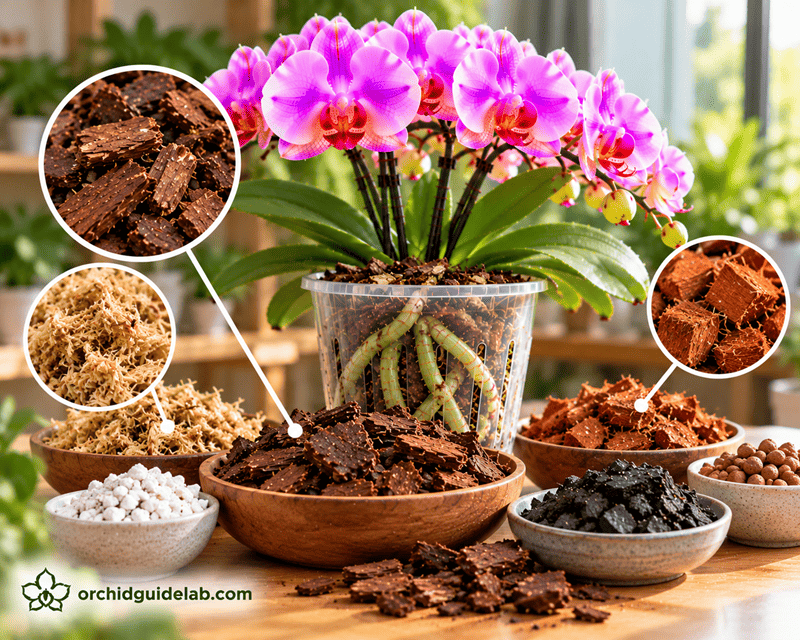
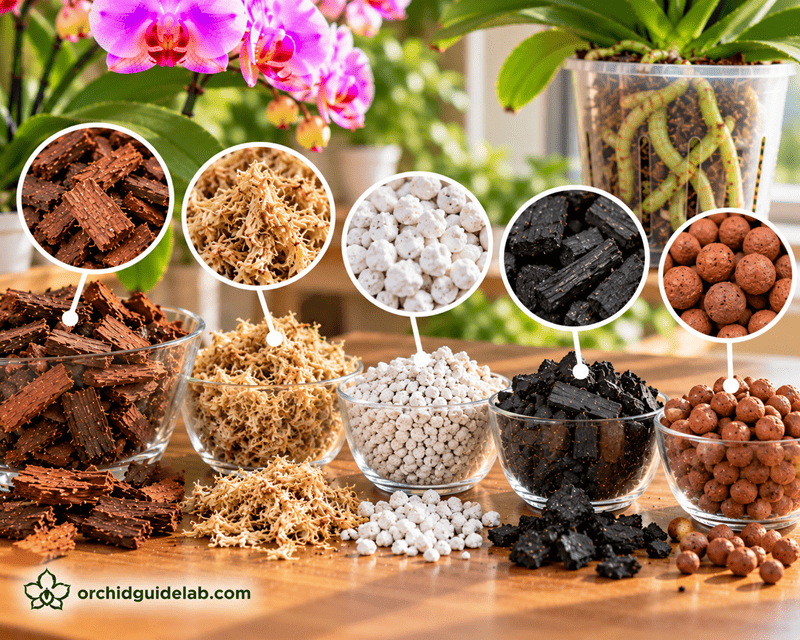
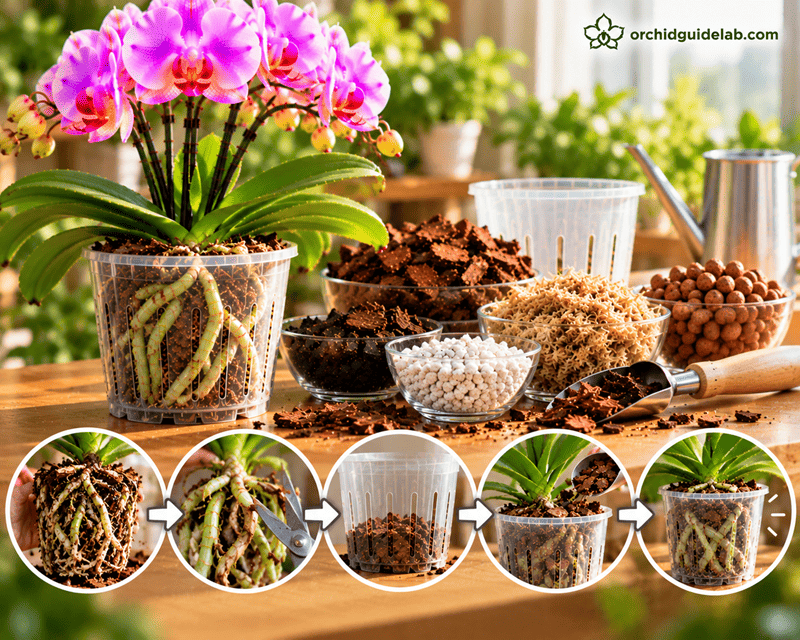
For most indoor Phalaenopsis orchids, a coarse, airy orchid mix based on bark is an excellent starting point. Sphagnum moss can increase moisture retention, while materials such as perlite can help maintain an open structure.
Orchid roots are different from the roots of many ordinary houseplants. Phalaenopsis orchids naturally grow with substantial air around their roots, so dense garden soil or standard houseplant potting soil is usually unsuitable.
There is no single perfect orchid mix for every home. The best choice depends on humidity, temperature, airflow, pot type, root condition and how often you water.
What makes a good orchid potting mix?
- good airflow around the roots;
- fast drainage after watering;
- enough moisture retention for the growing environment;
- a structure that does not compact easily;
- materials that remain stable between repottings;
- a particle size appropriate for the orchid and pot.
ROOT ENVIRONMENT
Why orchids need a different potting mix
Many commonly grown orchids, including Phalaenopsis, are epiphytes. In nature, their roots are adapted to environments where they receive both moisture and air.
A dense potting medium can fill the air spaces around orchid roots and remain wet for too long. This makes it harder to maintain the balance between hydration and aeration.
Orchid potting materials are therefore usually coarse rather than soil-like. Large particles create spaces where water can drain and air can circulate.
Key principle: orchid potting mix should support the roots without surrounding them with dense, permanently wet material.
ORCHID BARK
Bark-based orchid mix
Bark is one of the most widely used materials for growing Phalaenopsis orchids indoors. Its coarse pieces create spaces between particles, allowing water to drain and air to reach the roots.
Bark-based mixes are especially useful when orchids are grown in transparent pots with good drainage and ventilation.
The size of the bark pieces matters. Very fine material tends to hold more moisture and can compact more quickly, while larger pieces generally create more airflow and dry faster.
A medium-grade bark is often a practical choice for mature indoor Phalaenopsis orchids.
For more detail, read: Best Orchid Bark .
SPHAGNUM MOSS
Sphagnum moss for orchids
Sphagnum moss holds considerably more moisture than coarse bark. This can be useful in warm, dry environments or for orchids that dry too quickly between waterings.
The same moisture-holding ability can become a disadvantage when moss is packed too tightly or when an orchid is watered too frequently.
Loosely arranged sphagnum allows more air to remain around the roots than densely compressed moss.
When growing in sphagnum, monitor the moisture inside the pot rather than judging only by the dry appearance of the surface.
Learn more: Sphagnum Moss for Orchids .
COMPARISON
Orchid bark vs sphagnum moss
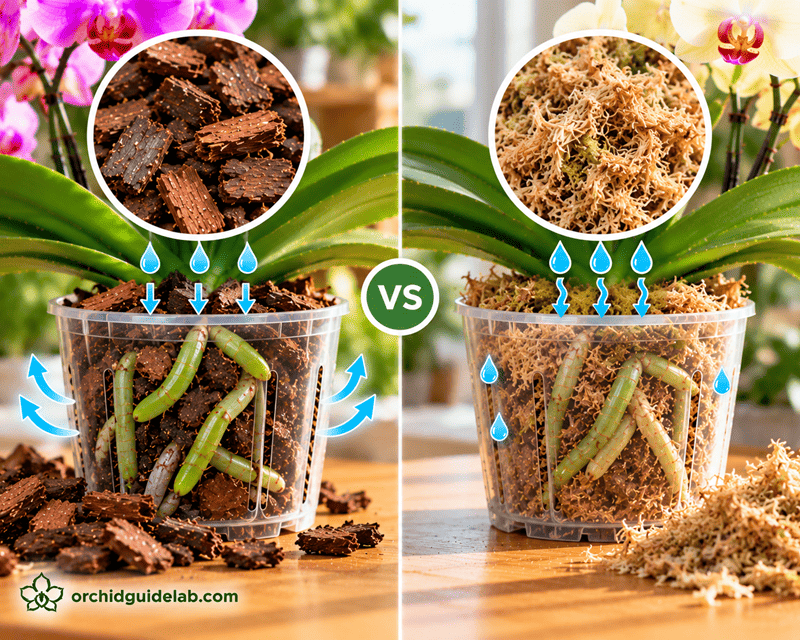
Bark and sphagnum moss can both support healthy orchids, but they create very different moisture conditions.
Coarse bark generally provides more open air spaces and tends to dry faster. Sphagnum moss retains more water and can keep the root zone moist longer.
Bark may be easier to manage for growers who tend to water frequently, while some orchids in dry environments may benefit from additional moisture retention.
Neither material is automatically better. The correct choice is the one that allows the roots to receive water and then return to a well-aerated condition at an appropriate rate.
Full comparison: Orchid Bark vs Sphagnum Moss .
PERLITE
Perlite in orchid potting mix
Perlite is a lightweight mineral material often included as one component of potting mixes.
Larger-grade perlite can help keep a mix open and reduce the tendency of smaller organic materials to pack tightly together.
It is usually used as an addition rather than as the entire potting medium for a mature Phalaenopsis.
The goal is not to add as many ingredients as possible. Each component should contribute to the balance of drainage, airflow and moisture retention.
CHARCOAL
Charcoal in orchid mixes
Horticultural charcoal is sometimes included in commercial orchid mixes alongside bark and other coarse materials.
Chunky charcoal can contribute to an open, free-draining structure when used appropriately.
It is not essential for every orchid mix, and adding charcoal does not compensate for poor watering habits, insufficient drainage or badly decomposed bark.
A simple, well-managed bark-based mix can work perfectly well without a long list of additional ingredients.
OTHER MATERIALS
Coconut husk and other orchid media
Coconut husk chips, expanded clay and other coarse materials are also used in some orchid growing systems.
Each material has different moisture-holding, drainage and structural characteristics.
When switching to an unfamiliar medium, do not assume your previous watering routine will remain appropriate.
Observe how quickly the new medium dries and how the roots respond before settling into a new watering rhythm.
SIMPLE MIX
A simple potting mix for Phalaenopsis orchids
For many indoor Phalaenopsis orchids, you do not need a complicated recipe.
A coarse bark-based medium can be used alone when your environment and watering habits provide an appropriate drying cycle.
If the bark dries too quickly, a modest amount of moisture-retentive material such as sphagnum moss can be added.
If the mix tends to become too dense, coarse mineral components may help maintain larger air spaces.
Start simple: use coarse orchid bark as the foundation, then adjust moisture retention only when your growing conditions make it necessary.
YOUR HOME
Match the potting mix to your environment
The same orchid mix can behave very differently in two homes.
Warm temperatures, strong airflow, low humidity and small ventilated pots can cause a mix to dry rapidly.
Cooler temperatures, higher humidity, low airflow and less ventilated containers can keep the same material wet for much longer.
This is why choosing a potting mix should always be connected to your actual growing conditions rather than a universal recipe.
The goal is a predictable cycle: water reaches the roots, excess water drains away, and air returns to the root zone.
WATERING STYLE
Match the mix to how you water
Your watering habits are just as important as temperature and humidity.
If you tend to water frequently, an open bark-based mix may provide a larger margin for drainage and airflow.
If your orchids regularly become too dry between waterings, slightly more moisture-retentive material may help.
Avoid trying to solve every watering problem by adding more moss. Sometimes the better solution is simply adjusting when and how you water.
Read: How to Water Orchids Indoors .
POT + MIX
Your orchid pot changes how the mix behaves
Potting mix cannot be evaluated separately from the container holding it.
A transparent orchid pot with numerous drainage and ventilation openings can dry more quickly than a closed container with only a few holes.
Pot size also matters. A large volume of moisture-retentive medium around a relatively small root system may remain wet for too long.
Match the pot, mix and root system together rather than choosing each one independently.
See: Best Pots for Orchids .
PARTICLE SIZE
Fine vs coarse orchid potting mix
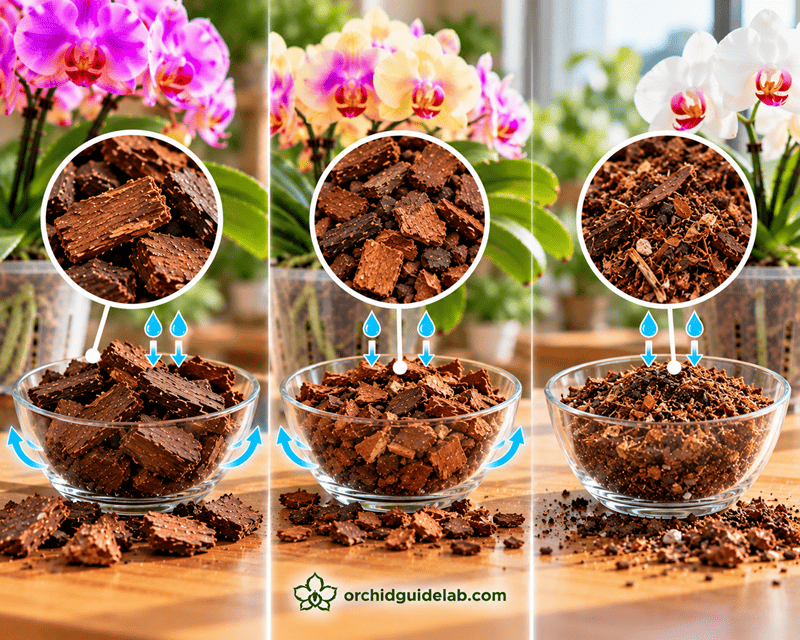
Particle size strongly influences the amount of air and moisture inside a pot.
Coarse materials create larger spaces between particles and usually allow faster drainage. Fine materials create smaller spaces and generally retain moisture for longer.
This does not mean coarse is always good and fine is always bad. The ideal structure depends on the size and condition of the roots, the container and the growing environment.
AGING MIX
Why old orchid potting mix needs replacing
Organic materials such as bark gradually change as they age.
Bark pieces soften, break into smaller fragments and begin filling the spaces that previously allowed air to move through the root zone.
An orchid that once dried at a healthy rate may begin remaining wet much longer as the medium deteriorates.
This is one reason repotting is necessary even when the orchid does not need a significantly larger container.
Learn when replacement is needed: When to Repot an Orchid .
AVOID
Can you use regular potting soil for orchids?
Standard houseplant potting soil is generally too dense and moisture-retentive for epiphytic Phalaenopsis orchids.
Fine soil particles fill the spaces around roots and can greatly reduce airflow.
Instead, use a potting medium specifically designed to maintain an open root environment, such as coarse orchid bark or an appropriate orchid mix.
Avoid ordinary soil: Phalaenopsis roots need an open, well-aerated medium rather than dense conventional houseplant compost.
REPOTTING
How to replace orchid potting mix
Prepare fresh potting material, a suitable orchid pot and clean tools before removing the orchid from its container.
Gently remove the old medium and inspect the root system. Preserve firm healthy roots and trim only roots that are clearly dead, hollow or severely damaged.
Position the orchid in the container and add fresh mix around the roots without packing it excessively tightly.
Keep the crown above the potting medium and make sure the plant is stable.
Full instructions: How to Repot an Orchid .
QUICK CHECK
Orchid potting mix checklist
Choose a mix that allows excellent drainage and keeps air around the roots.
Use coarse bark as a practical starting point for many indoor Phalaenopsis orchids.
Add moisture-retentive material only when your environment and watering routine require it.
Replace organic medium when it becomes soft, compacted or badly decomposed.
Compare Bark and Moss →COMMON MISTAKES
Common orchid potting mix mistakes
- Using ordinary potting soil. Dense soil can greatly reduce airflow around Phalaenopsis roots.
- Packing sphagnum moss too tightly. Compressed moss can remain wet for a long time.
- Using very fine decomposed bark. Small particles reduce the open structure of the root zone.
- Ignoring the type of pot. The same mix dries differently in different containers.
- Using a mix that is too moisture-retentive. This can be difficult to manage in cool or humid conditions.
- Using a mix that dries too quickly. Very coarse media may require more frequent watering in dry conditions.
- Keeping the same watering schedule after changing media. A new mix may have a completely different drying rate.
- Leaving decomposed medium around healthy roots. Old material gradually loses its open structure.
Simple rule: choose the mix that gives your orchid roots enough moisture without sacrificing airflow.
SIMPLE ROUTINE
Build the potting mix around your orchid's roots
The best orchid potting mix is not necessarily the one with the most ingredients. A simple mix that produces a healthy wet-dry cycle is often easier to manage.
For many indoor Phalaenopsis orchids, coarse bark provides a useful balance of drainage and airflow. Sphagnum moss can increase moisture retention, while coarse mineral materials can help maintain an open structure.
Watch how quickly the pot dries and how the roots respond. Adjust the mix when your environment consistently keeps it too wet or too dry.
Most importantly, replace aging organic material before it becomes heavily decomposed and compacted. Healthy orchid roots need water, but they also need air.
READ NEXT
More orchid potting guides
Orchid Bark vs Sphagnum Moss
Compare airflow, moisture retention and watering needs.
Best Orchid Bark
Learn how to choose bark for healthy orchid roots.
Sphagnum Moss for Orchids
Learn how to use moisture-retentive moss correctly.
How to Repot an Orchid
Replace old medium and repot your orchid step by step.
When to Repot an Orchid
Recognize when old potting mix needs replacement.
Best Pots for Orchids
Match the right pot with your orchid potting mix.