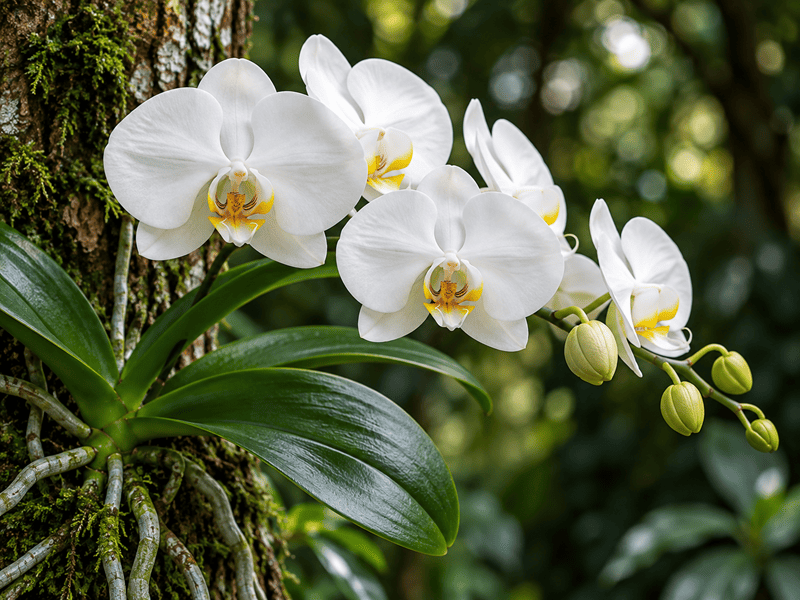
Description of Phalaenopsis amabilis
Phalaenopsis amabilis belongs to the genus Phalaenopsis in the family Orchidaceae. Plants of the World Online recognizes Phalaenopsis amabilis (L.) Blume as the accepted name.
The species was published in the genus Phalaenopsis by Carl Ludwig Blume in 1825. It is a botanical species and should not automatically be identified with every large white Phalaenopsis sold in stores.
Natural distribution
The native range of Phalaenopsis amabilis extends from Malesia to northeastern Australia.
According to Kew, the species occurs naturally in areas including Borneo, Java, the Lesser Sunda Islands, the Moluccas, New Guinea, the Philippines, Sulawesi, Sumatra and Queensland.
Important: a species' native range should not be converted directly into a fixed home-watering schedule. Drying speed depends on the substrate, pot, temperature, light, air movement and the condition of the roots.
Growth habit
Phalaenopsis amabilis is associated with wet tropical biomes and is primarily epiphytic.
In nature, the plant can attach itself to trees, so its root system is adapted to an environment with good access to air.
Leaves
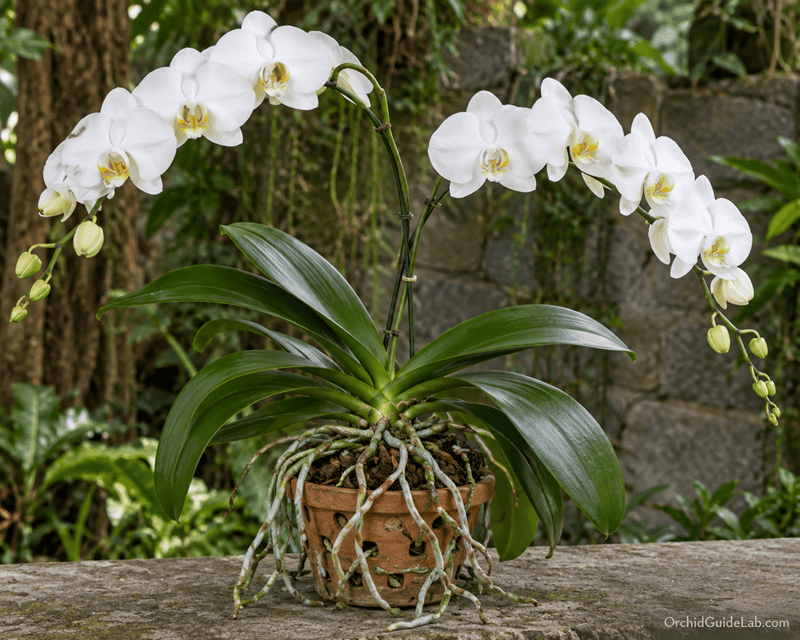
Phalaenopsis amabilis typically has broad, thick, leathery green leaves.
Like other Phalaenopsis, it grows monopodially. New leaves emerge from the central growing point, and Phalaenopsis do not form pseudobulbs.
Roots
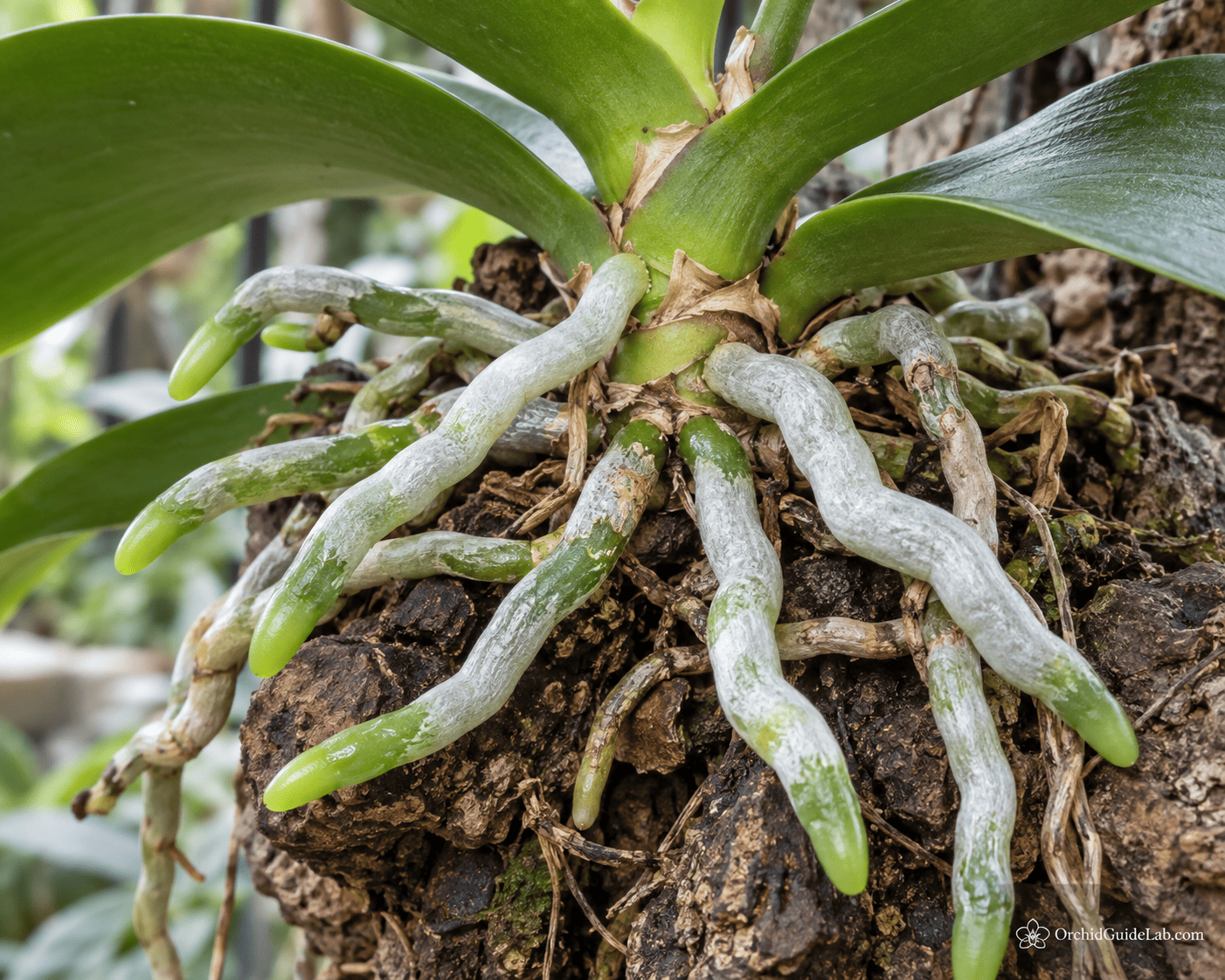
The roots of Phalaenopsis amabilis are thick and adapted to an epiphytic way of life.
Some roots may grow outside the potting medium. These aerial roots should not be cut off simply because they extend beyond the pot.
Flowers
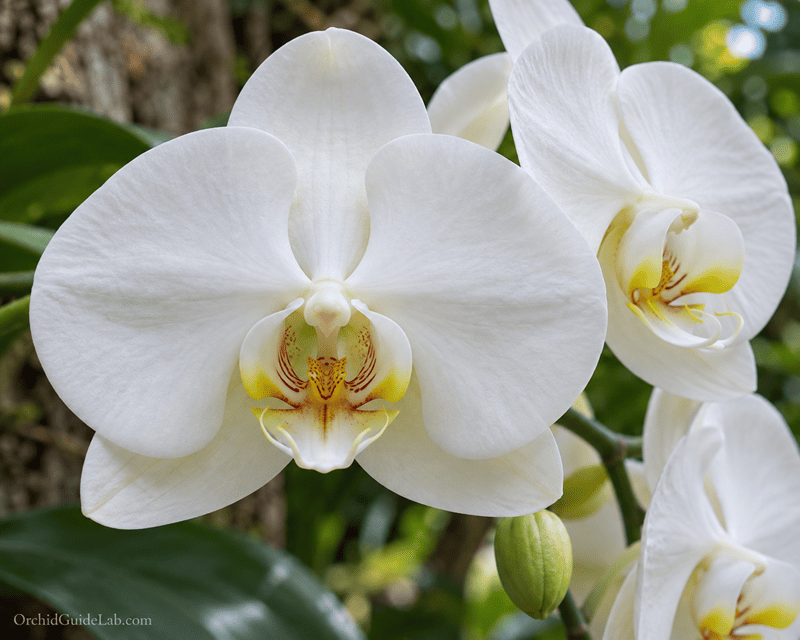
One of the most recognizable features of Phalaenopsis amabilis is its pale flowers. The sepals and petals are mainly white, while the lip carries contrasting yellow and reddish details.
The flower spike may branch and carry several flowers. Flower number, flower size and blooming duration can vary between plants and with growing conditions.
Phalaenopsis amabilis photos
Click a photo to open a larger view.

Phalaenopsis amabilis video
Watch Phalaenopsis amabilis in bloom, including its elegant white flowers, green leaves, aerial roots and the overall structure of the plant.
Accepted infraspecific taxa
Plants of the World Online lists several accepted infraspecific taxa within Phalaenopsis amabilis.
Synonyms
Other names have been used during the botanical history of this species. Kew lists homotypic synonyms including Epidendrum amabile, Cymbidium amabile and Synadena amabilis.
Orchid Guide Lab uses the accepted name Phalaenopsis amabilis as the primary name for this page.
Phalaenopsis amabilis care at home
When growing Phalaenopsis amabilis, its epiphytic growth habit is important. The roots need access to air.
Bright, filtered light works well for many Phalaenopsis. Strong direct sunlight through glass can overheat and damage the leaves.
Watering should not follow only a fixed calendar. Before watering again, consider the condition of the substrate and roots, the temperature, ventilation and the rate at which the pot dries.
Do not rely only on a rule such as “water once a week.” In one room the substrate may dry quickly, while in another it may remain moist for much longer.
Phalaenopsis amabilis and white store-bought orchids
The name Phalaenopsis amabilis refers to a specific botanical species. It is not a general name for every white Phalaenopsis orchid.
Many large white orchids sold without a complete name are complex horticultural hybrids. A plant should not automatically be identified as Phalaenopsis amabilis based only on the appearance of its flowers.
Sources
Taxonomic status, authorship, natural range, growth habit, infraspecific taxa and synonyms are checked against botanical sources.