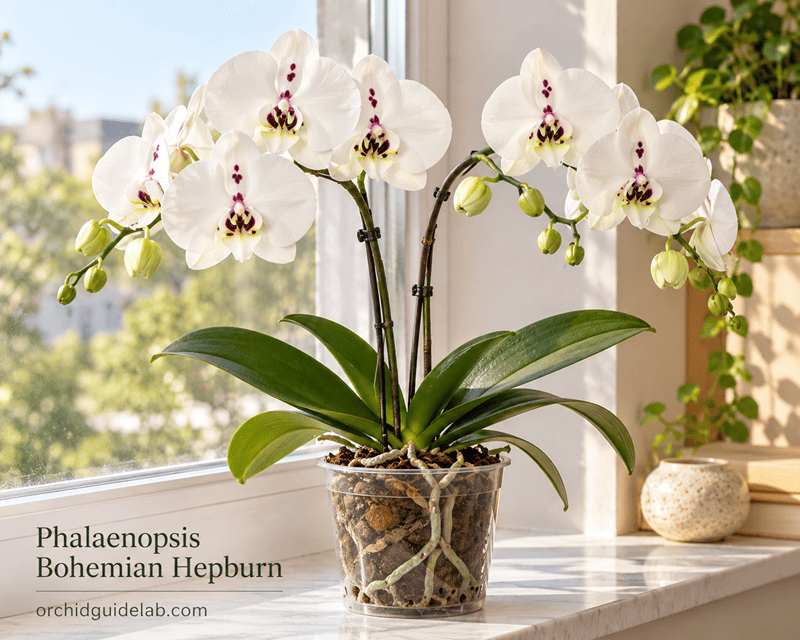
Phalaenopsis Bohemian Hepburn Description
Phalaenopsis Bohemian Hepburn stands out for its predominantly white flowers and small but distinctive dark markings. The broad, rounded petals have a delicate natural texture and may show subtle creamy undertones in warm daylight.
The reference flower displays three dark purple-magenta spots on the upper sepal, positioned close to the center. The lip combines a white base with rich burgundy-purple details and delicate yellow accents. These contrasting colors create the flower's distinctive appearance.
Main Characteristics
| Name | Phalaenopsis Bohemian Hepburn |
|---|---|
| Genus | Phalaenopsis |
| Family | Orchidaceae |
| Type | Ornamental Phalaenopsis orchid |
| Flower color | White with dark purple accents |
| Flower shape | Broad, rounded petals |
| Flower pattern | Three dark purple spots on the upper sepal of the reference flower |
| Lip | White with burgundy-purple and yellow details |
| Lighting | Bright, indirect light |
| Watering | When the bark has noticeably dried |
| Potting medium | Airy orchid bark mix |
What Makes Bohemian Hepburn Special?
The most recognizable feature of Bohemian Hepburn is the contrast between its broad white petals and the small dark purple spots on the upper sepal. The markings are concentrated near the flower's center, allowing the overall appearance to remain bright and elegant.
The lip is especially interesting when viewed up close. Its deep burgundy and purple areas contrast with the white base and delicate yellow details. The combination creates a striking focal point without covering the main petals in heavy patterns.
How to Care for Phalaenopsis Bohemian Hepburn
Bohemian Hepburn can be cared for using the general principles recommended for indoor Phalaenopsis orchids. Place the plant near a window with bright, indirect light and protect it from prolonged direct midday sunlight.
Water when the bark inside the pot has noticeably dried. Avoid watering on a rigid schedule: drying time depends on temperature, humidity, air circulation, and pot size.
Practical tip: use a transparent orchid pot with drainage holes and a loose bark mix. This makes it easier to observe root condition and moisture levels. After watering, allow excess water to drain completely.
Avoid leaving the pot standing in water or allowing moisture to collect in the crown between the leaves. During active growth, you can apply diluted orchid fertilizer according to the manufacturer's instructions.
After Flowering
Continue normal care after the flowers have faded. A completely dry flower spike can be removed using a clean tool. If the spike remains green, immediate pruning is not necessary.
Repot when the bark breaks down, holds moisture for too long, or the roots show signs of trouble. If the roots are healthy and the potting medium remains airy, immediate repotting is usually unnecessary.
Phalaenopsis Bohemian Hepburn Photos
Explore a close-up of the white flower, an elegant arching spike with buds, a greenhouse growing illustration, and an abundant flowering display in a bright home interior. Click any image to enlarge it.


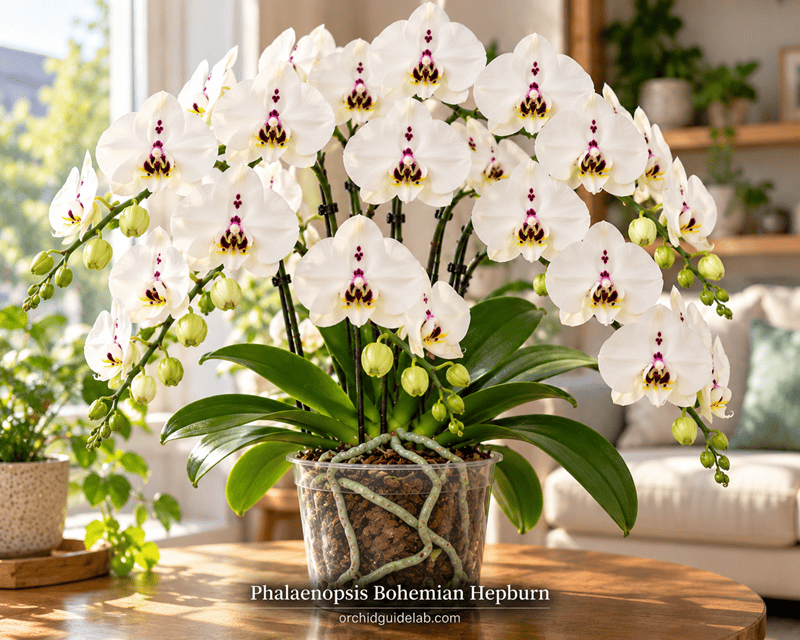
Illustrative images were created using artificial intelligence based on the reference flower photograph.
Phalaenopsis Bohemian Hepburn Video
Watch this short cinematic video of Phalaenopsis Bohemian Hepburn. Enjoy its elegant white petals, distinctive purple spots, gentle natural movement, and a smooth camera close-up accompanied by relaxing music.
Frequently Asked Questions
What color are Phalaenopsis Bohemian Hepburn flowers?
The flowers are predominantly white, with dark purple spots on the upper sepal and burgundy-purple markings on the lip.
What light does Phalaenopsis Bohemian Hepburn need?
Bright, indirect light is ideal. Avoid prolonged exposure to direct midday sunlight.
When should I water Phalaenopsis Bohemian Hepburn?
Water when the bark inside the pot has noticeably dried. Watering frequency depends on temperature, humidity, and air circulation.
Should I repot Bohemian Hepburn immediately after purchase?
Immediate repotting is usually unnecessary if the roots are healthy and the potting medium is airy and drains well.