
Description of Phalaenopsis celebensis
Phalaenopsis celebensis H.R.Sweet belongs to the family Orchidaceae. Kew's Plants of the World Online recognizes this name as accepted for a distinct botanical species.
The species was published by Herman Royden Sweet in 1980 in the monograph The Genus Phalaenopsis .
Etymology
The specific epithet celebensis is linked to the former name of Sulawesi Island—Celebes.
The botanical name therefore directly reflects the species' geographic origin.
Natural range
According to current Kew and World Flora Online data, the native range of Phalaenopsis celebensis is restricted to Sulawesi, Indonesia.
The species grows epiphytically and is associated mainly with a wet tropical biome.
Smithsonian collection data report habitat elevations of approximately 400–600 m.
Plant size
Phalaenopsis celebensis is considered a miniature species, although its flower spikes can be much longer than the leaf rosette itself.
Leaves
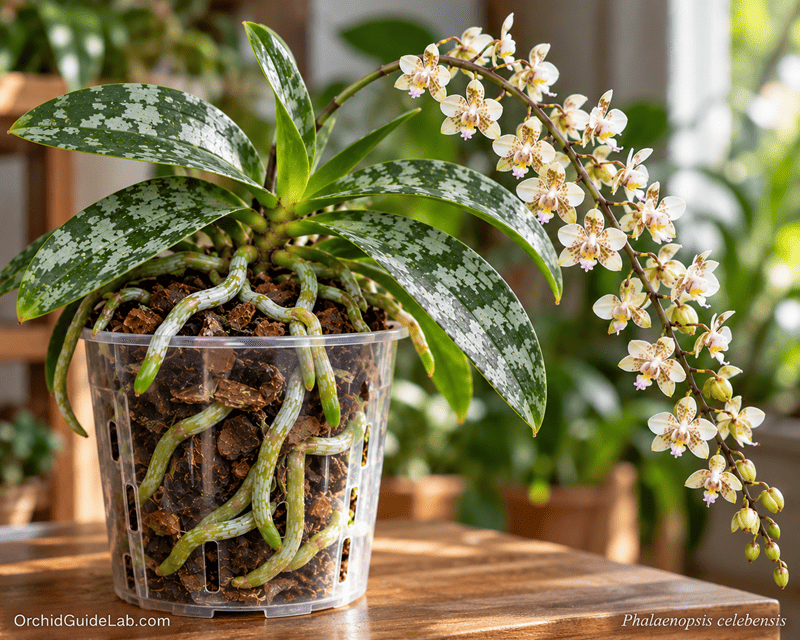
The foliage is one of the species' most distinctive features. The leaves are elongated-obovate, dark green and decoratively mottled with silver-gray markings.
The silvery markings may form characteristic transverse bands or irregular rows, keeping the plant ornamental even when it is not in bloom.
Botanical descriptions report leaves up to about 17 cm long and around 6 cm wide.
Important for identification: Phalaenopsis celebensis should not have the plain, uniformly green foliage typical of a mass-market Phalaenopsis. The silver-gray pattern on a dark green background is one of the species' key visual traits.
Phalaenopsis celebensis flowers
The flowers are small, about 3–3.5 cm across. Their basic color is white to creamy white.
Brownish markings are present in the central part of the petals. Brown stripes are also visible near the base of the lip.
The sepals remain much paler, without the pronounced brown coloration seen in the central areas of the petals.
Flower shape
The flower has a more delicate botanical form than large-flowered commercial Phalaenopsis hybrids.
The dorsal sepal may curve backward, while the lateral sepals point slightly inward.
For that reason, photographs of the species should not depict the flowers as overly round, flat or unnaturally large.
Inflorescence
The inflorescence is long and many-flowered, reaching approximately 40–60 cm.
The flower spike may initially grow sideways or in an arch, becoming pendent as it lengthens.
The flower spike may be purple-green. Flowers open gradually, beginning from the lower part of the inflorescence.
Flowering period
Cultivation references often mention flowering in July and August for Phalaenopsis celebensis.
In home cultivation, exact timing may vary depending on temperature, light and the overall growing regime.
Phalaenopsis celebensis photos
Click a photo to open a larger view.


Phalaenopsis celebensis video
Watch Phalaenopsis celebensis in this short video: small pale flowers with brownish markings, a long many-flowered inflorescence, silver-mottled leaves, roots and the overall appearance of the plant.
Synonymy
The current Plants of the World Online profile lists no separate botanical synonyms for Phalaenopsis celebensis. The accepted name is Phalaenopsis celebensis H.R.Sweet .
Phalaenopsis celebensis and similar species
When identifying the species, it is important to evaluate not only the flower but also the leaves and the overall character of the inflorescence.
The combination of dark green silver-mottled leaves, a long many-flowered spike and small white flowers with a brownish center helps distinguish Phalaenopsis celebensis from many other botanical species.
Phalaenopsis celebensis care
The species comes from wet tropical habitats, so it benefits from stable moisture together with good root ventilation.
For this species, it is especially important not to confuse high air humidity with a constantly waterlogged substrate.
Pot and substrate
Indoors, Phalaenopsis celebensis can be grown in a transparent, ventilated pot.
An airy bark substrate with a particle size appropriate for the root system is suitable.
The pot should not be disproportionately large, because excess wet substrate will dry more slowly.
Watering
Specialized orchid sources recommend regular moisture throughout the year for this species.
In home cultivation, watering frequency should be adjusted according to root condition, temperature, ventilation and how quickly the bark dries.
Practical tip: a transparent pot makes it easier to monitor root condition and substrate moisture without unnecessary disturbance.
Light
In nature, Phalaenopsis celebensis grows as an epiphyte under the cover of tropical vegetation.
At home, soft bright filtered light is suitable without prolonged exposure to strong direct sun.
Temperature
The species comes from tropical Sulawesi, and specialized sources place it in a warm to intermediate-warm growing range.
In home cultivation, stable conditions are more important than attempting to reproduce isolated extreme temperature values.
Humidity and ventilation
Higher humidity should be combined with constant gentle air movement.
It is especially important that water does not remain for long periods between the leaves or around the crown and root base.
What makes Phalaenopsis celebensis special
This is one of the species whose ornamental value is not limited to flowering.
The silver-mottled foliage is striking on its own, and during flowering the plant produces long inflorescences with many small pale flowers.
Sources
The accepted name, authorship, publication date, native range, growth habit and biome were checked against Kew and IPNI. Data on flowers, leaves, inflorescences and elevation range were compared with Smithsonian Gardens and specialized orchid sources.