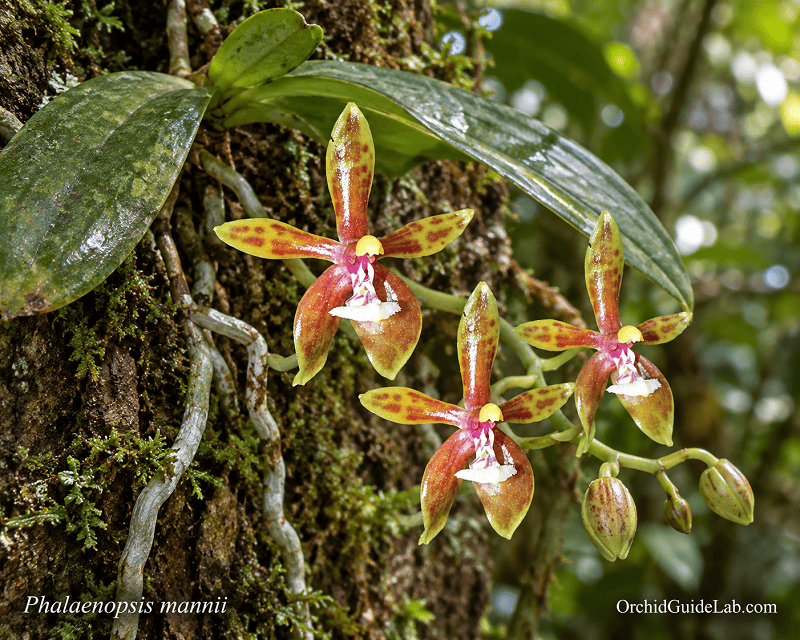
About Phalaenopsis mannii
Phalaenopsis mannii Rchb.f. is a botanical orchid species in the family Orchidaceae. It was described by Heinrich Gustav Reichenbach in 1871, with the name published in The Gardeners' Chronicle, on page 902.
Kew Plants of the World Online currently recognizes Phalaenopsis mannii as an accepted species. Unlike the complex Phalaenopsis hybrids commonly sold as houseplants, it has its own distinctive floral anatomy and natural distribution.
The name commemorates Gustav Mann, a nineteenth-century botanical collector. The species is sometimes referred to as Mann's Phalaenopsis in English-language orchid literature.
The orchid is particularly recognized for glossy, waxy flowers with yellow-green segments, dark reddish-brown markings and a contrasting white lip.
Native Range and Distribution
According to Kew POWO, Phalaenopsis mannii is native from eastern Nepal to southern Yunnan, China.
Its natural distribution includes Nepal, the eastern Himalayas, northeastern India (including Assam), Myanmar, Vietnam and southern China.
Botanical references also mention Bhutan and Sikkim. The species is associated mainly with humid forest environments across continental Asia, where climate and seasonal patterns can vary according to elevation.
Natural Habitat
Phalaenopsis mannii is primarily an epiphytic orchid growing on tree trunks in evergreen broad-leaved forests. It uses the supporting tree as a physical anchor without parasitizing it.
Flora of China describes populations at approximately 900–1,400 meters above sea level. The specialist IOSPE reference reports a wider elevation range of about 500–1,500 meters.
The species favors humid, sheltered situations, sometimes near rivers or streams. However, its exposed roots can dry gradually after rainfall instead of remaining submerged in a constantly wet medium.
Habitat insight: high atmospheric humidity does not mean the potting medium should remain saturated. Epiphytic orchid roots require both moisture and access to air.
Growth Habit
Phalaenopsis mannii has a monopodial growth habit. New leaves develop from a single terminal growing point on a relatively short stem. The plant does not produce pseudobulbs.
Fleshy leaves and aerial roots arise from the stem, while lateral inflorescences may grow outward, upward or downward.
The plant can produce an elegant spreading silhouette through its elongated leaves and arching flower spikes, despite its relatively short central stem.
Leaves
The leaves are green, elongated, slightly leathery and fleshy, often with a smooth, glossy surface.
According to Flora of China, plants commonly bear four or five leaves, measuring approximately 20–23 cm long and 5–6 cm wide.
Their shape is oblong-oblanceolate, with a narrowed base and generally pointed tip.
Healthy leaves are firm. Harsh direct sunlight may cause scorching, while damaged roots can lead to dehydration and wrinkled foliage.
Aerial Roots
Phalaenopsis mannii roots are covered with velamen, a specialized tissue that helps absorb moisture. They can be long, thick and curved.
In nature, roots attach to tree bark. Some grow openly along the surface, while others settle into moss or bark crevices.
In cultivation, living aerial roots sometimes extend outside the pot. They should not be removed simply because they are exposed.
Flowers of Phalaenopsis mannii
The flowers have an elegant, star-like appearance and a glossy, waxy surface. IOSPE reports a flower size of approximately 3–5 cm.
Petals and sepals are yellow or yellow-green with dark brown, chestnut or reddish-brown markings.
Pigmentation varies naturally between plants. Some flowers have small, scattered marks, while others display extensive, nearly continuous dark brown areas.
The petals are relatively narrow, and the sepals are elongated. The overall floral shape differs from the rounded flowers of modern large-flowered Phalaenopsis hybrids.
The supplied botanical reference clearly shows a tall dorsal sepal, two narrow spreading petals, brown-yellow lateral sepals and a distinctive white and purple lip.
Lip and Column Structure
The lip of Phalaenopsis mannii is three-lobed and structurally complex. The white mid-lobe may carry purple markings and has a distinctive anchor-shaped appearance.
Flora of China describes an irregular margin and a swollen tip on the middle lobe. The yellow column has prominent structures near its base.
Reliable species identification should consider these floral characteristics together with the petals, sepals and overall flower pattern.
Inflorescence
Flower spikes can be ascending or pendulous, usually unbranched but occasionally branched. They may carry a few or numerous flowers.
Flora of China reports inflorescences approximately 5.5–30 cm long. IOSPE also describes longer spikes reaching about 45 cm.
Flowers can open successively, which may extend the decorative period of an inflorescence.
Fragrance
Specialist orchid references describe a fragrance sometimes compared to mandarin oranges or other sweet citrus fruits.
Fragrance intensity may vary between individual plants and according to temperature, time of day and flower maturity.
Flowering Season
The species generally flowers in spring. Flora of China specifically records March and April.
Under cultivated conditions, flowering time can change with light, temperature, seasonal growth patterns and root health.
Growth may slow during cooler months, requiring adjustments to watering and feeding without excessively drying living roots.
Phalaenopsis mannii Photo Gallery
Select a photograph to view it enlarged. These images are AI-generated artistic botanical visualizations based on the supplied reference.


Phalaenopsis mannii Video
Watch a short Orchid Guide Lab botanical visualization. Phalaenopsis mannii grows on a moss-covered tree in a humid forest. Its glossy spotted flowers gently sway in the breeze as the camera slowly moves closer, revealing the intricate brown markings and contrasting lip.
This video is an AI-generated artistic botanical visualization, not documentary footage of a wild orchid.
Taxonomy and Synonyms
The currently accepted scientific name is Phalaenopsis mannii Rchb.f., published in 1871.
Kew POWO lists Polychilos mannii (Rchb.f.) Shim, Phalaenopsis boxallii Rchb.f. and Phalaenopsis mannii f. flava Christenson among its synonyms.
These historical names reflect changes in orchid taxonomy and the recognition of particular forms. Orchid Guide Lab follows the current accepted name used by Kew.
Variation in Flower Color
Phalaenopsis mannii shows natural variation in the amount of dark pigmentation on its floral segments.
Some plants have predominantly yellow-green flowers with scattered brown spots, while others produce much darker flowers with broad, connected markings.
Differences in color alone do not necessarily indicate separate botanical taxa. Identification also depends on the lip, column and other floral structures.
Rarity and Conservation
Phalaenopsis mannii is less commonly encountered in ordinary flower shops than large-flowered commercial Phalaenopsis hybrids.
It is particularly valued by collectors interested in naturally occurring orchid species. Commercial availability, however, does not establish the species' official conservation status.
Collectors should prefer legally nursery-propagated orchids from reputable suppliers.
Phalaenopsis mannii Care
Phalaenopsis mannii benefits from filtered light, suitable atmospheric humidity, good air circulation and a freely draining growing medium.
The species has seasonal growth tendencies. In cooler periods with lower light, watering may need to be reduced, but living roots should not remain severely dehydrated.
Temperature
A practical starting range is approximately 21–27°C during the day and 16–21°C at night. These are cultivation guidelines rather than rigid physiological limits.
Avoid prolonged chilling of wet roots and abrupt temperature changes.
Lighting
Provide bright filtered light without harsh direct midday sunshine. An east-facing window can be suitable in many indoor environments.
Insufficient light may slow growth and reduce flowering.
Humidity
A practical starting point is approximately 60–80% relative humidity. Adequate air movement is essential, especially in an enclosed orchid growing cabinet.
Watering
During active growth, water regularly while allowing the bark to become partially dry between waterings.
Avoid watering strictly according to a calendar. Consider temperature, light, ventilation, root condition and the actual moisture level of the medium.
Winter Conditions
A drier seasonal period can occur in the natural habitat. Under cooler indoor conditions, watering may be reduced carefully when growth slows.
In a warm room with very dry air, prolonged complete dehydration may damage the roots.
Potting Medium
Medium-grade orchid bark is a practical starting potting material. A little sphagnum moss may be added where additional moisture retention is appropriate.
Keep the medium airy and free-draining rather than tightly compacted.
Transparent Ventilated Pot
A clear pot with drainage and ventilation openings makes it easier to observe the roots and drying of the bark.
Avoid an oversized pot, where excess medium can remain wet for too long.
Mounted Cultivation
As an epiphyte, Phalaenopsis mannii can also be grown mounted on cork or a suitable wooden support in a humid environment.
Mounted roots usually dry faster and may need more frequent watering.
Fertilizing
Use diluted orchid fertilizer during active growth. Flush the growing medium periodically with clean water to reduce mineral salt accumulation.
Repotting
Repot when bark breaks down, becomes compacted or no longer provides adequate root aeration. The beginning of new root growth is often a suitable time.
Growing tip: an appropriate cycle of watering and drying is more important than following a fixed weekly schedule. Observe the roots and the potting medium.
Common Growing Problems
Root Rot
Overwatering, degraded potting material and poor ventilation may damage roots. Review drainage, watering and root health.
Yellowing Leaves
Possible causes include natural leaf aging, excessive sunlight, root problems and sudden environmental changes.
Limp or Wrinkled Leaves
This may indicate inadequate water supply or roots that can no longer absorb moisture. Inspect the roots before watering more heavily.
Failure to Bloom
Review light, plant maturity, root condition and seasonal growing conditions. Do not use severe chilling to force flowering.
Bud Drop
Sudden temperature changes, drafts, dehydration, poor light or root damage may contribute to bud loss.
Dark Spots on Flowers
Brown spots and bars are a natural feature of the species. However, wet, soft or rapidly spreading lesions may indicate disease.
Frequently Asked Questions
Where does Phalaenopsis mannii grow?
From eastern Nepal and the eastern Himalayas to Myanmar, Vietnam and southern Yunnan in China.
What color are the flowers?
Mostly yellow or yellow-green with dark brown spots and stripes. The lip is white with purple details.
How large are its flowers?
Approximately 3–5 cm, according to IOSPE.
When does Phalaenopsis mannii bloom?
Usually in spring. Flora of China records flowering in March and April.
Does Phalaenopsis mannii have a fragrance?
Specialist descriptions mention a sweet fragrance resembling mandarin oranges.
Does it need a dry winter rest?
Watering can be reduced during cooler, slower-growing periods, but severe prolonged dehydration should be avoided.
Can it grow in a clear orchid pot?
Yes. Use a ventilated pot with an airy bark-based growing medium.
Is Phalaenopsis mannii a hybrid?
No. It is a naturally occurring botanical species described in 1871.
Is it suitable for beginners?
It is best suited to growers with some experience managing epiphytic orchid roots, light and moisture.
Phalaenopsis mannii vs. Common Phalaenopsis Hybrids
Many Phalaenopsis orchids sold in stores are complex horticultural hybrids selected for their large, rounded flowers.
Phalaenopsis mannii differs in having elongated waxy floral segments, naturally spotted coloration and a distinctive three-lobed lip. These characteristics make it especially interesting to botanical orchid collectors.
Botanical References
The accepted name, authorship, native distribution, synonyms, floral morphology and flowering season were checked against botanical references.