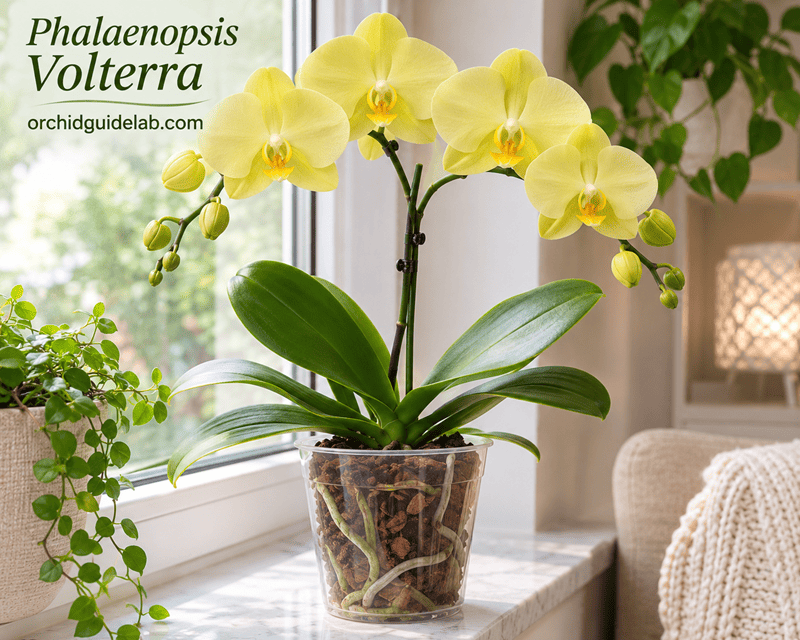
Phalaenopsis Volterra Flower Description
Phalaenopsis Volterra stands out for its soft, delicate flower coloring. The blooms are pale yellow with gentle lemon tones. Their petals appear mostly uniform in color, without prominent dark spots or contrasting stripes.
The lateral petals are broad and rounded, with smooth, gently curved edges. The upper sepal has a slightly more elongated shape, while the lower sepals complete the flower's balanced, rounded outline. The petal surface has a delicate, slightly silky appearance.
At the center of each flower is a small lip with cream, yellow and warm orange accents. These brighter details add depth and definition without overpowering the flower's soft, elegant appearance.
Main Characteristics
| Name | Phalaenopsis Volterra |
|---|---|
| Genus | Phalaenopsis |
| Family | Orchidaceae |
| Category | Ornamental Phalaenopsis orchid |
| Main Flower Color | Pale yellow with soft lemon tones |
| Petal Pattern | Mostly uniform, without prominent dark spots |
| Flower Shape | Rounded, with broad lateral petals |
| Lip | Light-colored with yellow and orange details |
| Light | Bright, indirect sunlight |
| Watering | After the bark has dried sufficiently |
| Potting Medium | Well-aerated orchid bark |
What Makes Phalaenopsis Volterra Special?
The main attraction of Phalaenopsis Volterra is the combination of its gentle yellow coloring and harmonious flower shape. Unlike orchids with bold spots or strongly contrasting veins, Volterra has a calm, understated appearance.
Its soft lemon-yellow flowers complement green foliage, light-colored furniture and natural materials. This orchid is especially attractive on a bright windowsill where diffused daylight enhances the delicate shades of its petals.
How to Care for Phalaenopsis Volterra
Phalaenopsis Volterra can be grown using the general care principles recommended for commonly cultivated Phalaenopsis orchids. The essentials are adequate indirect light, careful watering and an airy potting medium. Keeping the roots healthy is particularly important.
Light Requirements
Choose a location with bright but indirect light. An east-facing window or another well-lit windowsill protected from strong midday sunshine can work well. Excessive direct sunlight may cause leaf burns.
Watering
Water when the bark inside the pot has dried sufficiently. Avoid following a rigid watering schedule: the growing medium may dry more quickly in warm conditions and much more slowly in a cooler room.
Practical tip: check the moisture level inside the pot, not just on the surface of the bark. A transparent orchid pot makes it easier to inspect the roots. Always let excess water drain away completely.
Temperature and Humidity
Phalaenopsis Volterra can be kept at normal, comfortable indoor temperatures. Avoid cold drafts, sudden temperature changes and placing the orchid directly next to a radiator. Moderate humidity and gentle air circulation help maintain healthy growth.
Potting Medium and Fertilizer
Use a suitable orchid bark mix and a pot with drainage holes. Dense universal potting soil is not appropriate because Phalaenopsis roots need access to air. During active growth, an orchid fertilizer can be applied according to the manufacturer's instructions.
Care During and After Flowering
During flowering, try to keep the orchid's growing conditions stable. Avoid allowing the roots to become excessively dry, but never leave the pot standing in water. Do not let water collect in the crown between the leaves.
After the flowers fade, continue regular care. A completely dry flower spike can be removed with clean pruning tools. If the spike remains green, immediate removal is not always necessary.
When Should You Repot?
Repot when the bark begins to break down, becomes compacted or stays wet for too long. Routine repotting is often convenient after flowering. If the roots show signs of serious rot, address the problem without waiting for flowering to finish.
Phalaenopsis Volterra Photos
Delicate pale yellow flowers and broad, rounded petals give Phalaenopsis Volterra an elegant appearance. Select any photo below to view the orchid in greater detail.


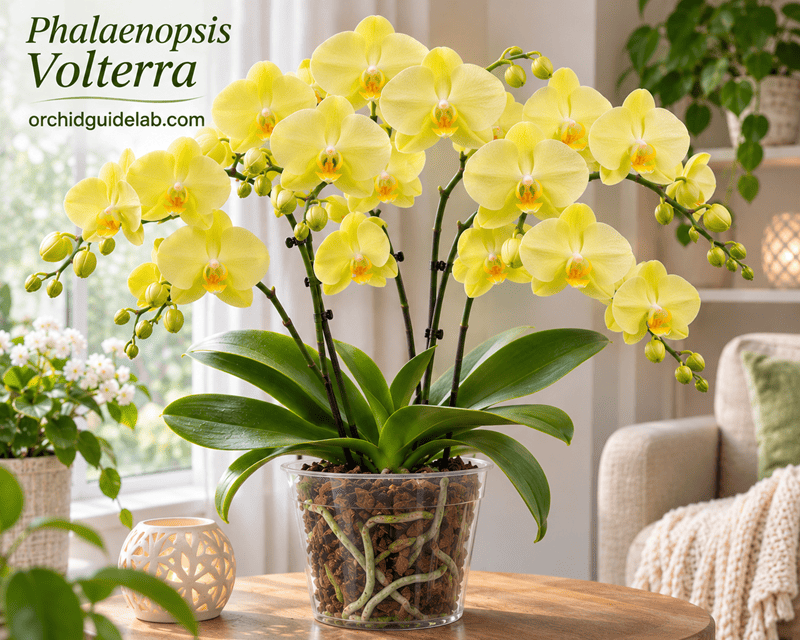
These images were created using artificial intelligence to reflect the original appearance of the plant.
Frequently Asked Questions
What color are Phalaenopsis Volterra flowers?
Phalaenopsis Volterra has soft, pale yellow flowers with delicate lemon tones. The center features brighter yellow and small orange accents.
How much light does Phalaenopsis Volterra need?
Phalaenopsis Volterra grows best in bright, indirect light. Protect it from strong direct midday sunlight.
How often should I water Phalaenopsis Volterra?
Water when the bark inside the pot has dried sufficiently. The interval depends on temperature, humidity, pot size and the condition of the growing medium.
Should I repot Phalaenopsis Volterra after buying it?
Immediate repotting is usually unnecessary if the roots are healthy and the bark remains airy. Repot when the growing medium deteriorates or root problems appear.