ORCHID CARE
Spring Orchid Care
Spring brings longer days, stronger light and fresh growth to many indoor orchids. This is the time to monitor new roots and leaves, adjust watering, resume appropriate feeding and check whether your orchid needs repotting.
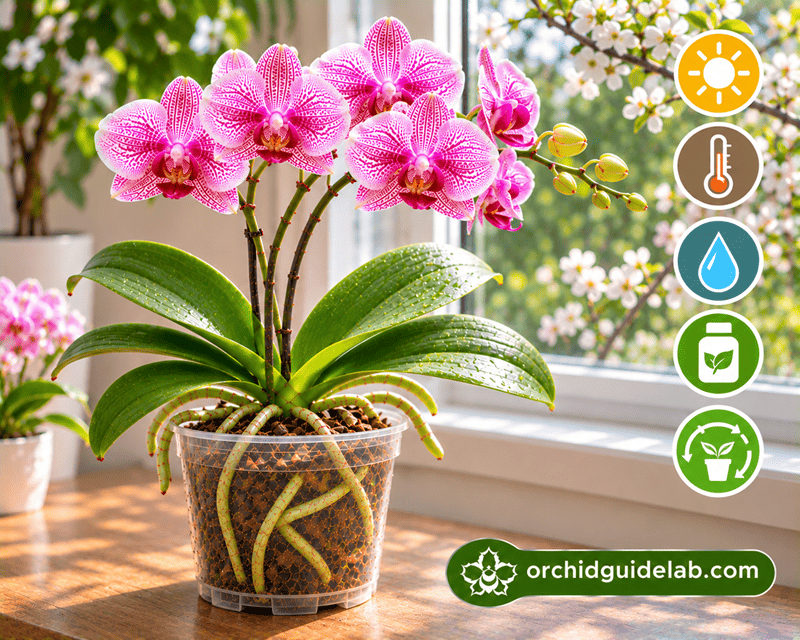
Spring orchid care focuses on responding to increasing light and active growth. Check the roots and potting medium more frequently, gradually adjust watering, provide bright indirect light and fertilize according to the plant's actual growth rather than simply following the calendar.
After the shorter and often cooler days of winter, many Phalaenopsis orchids begin producing fresh roots or leaves as spring conditions improve.
This seasonal transition can also change how quickly the potting medium dries. An orchid that needed relatively infrequent watering in winter may begin using moisture more quickly as temperatures and light levels increase.
Spring is therefore a useful time to observe the plant carefully and make gradual adjustments instead of suddenly changing every part of its routine.
Spring orchid care at a glance
- watch for new roots and leaves;
- provide bright indirect light;
- increase watering only when drying becomes faster;
- check roots before watering;
- fertilize appropriately during active growth;
- inspect the condition of the potting medium;
- repot when the orchid actually needs it;
- protect plants from sudden temperature changes.
SPRING CONDITIONS
What changes for orchids in spring?
Increasing daylight is one of the most important seasonal changes for indoor orchids.
Longer days can support photosynthesis and active growth, while gradually warmer indoor conditions may cause roots and potting medium to dry more quickly.
Healthy Phalaenopsis orchids may begin producing new root tips, fresh leaves or other visible signs of growth.
These changes do not happen at exactly the same time for every orchid. The plant's position, indoor temperature, window direction and individual growth cycle all matter.
Key spring rule: adjust care according to visible growth and changing conditions around the orchid, not simply because the calendar says spring has arrived.
ACTIVE GROWTH
Look for signs of new orchid growth
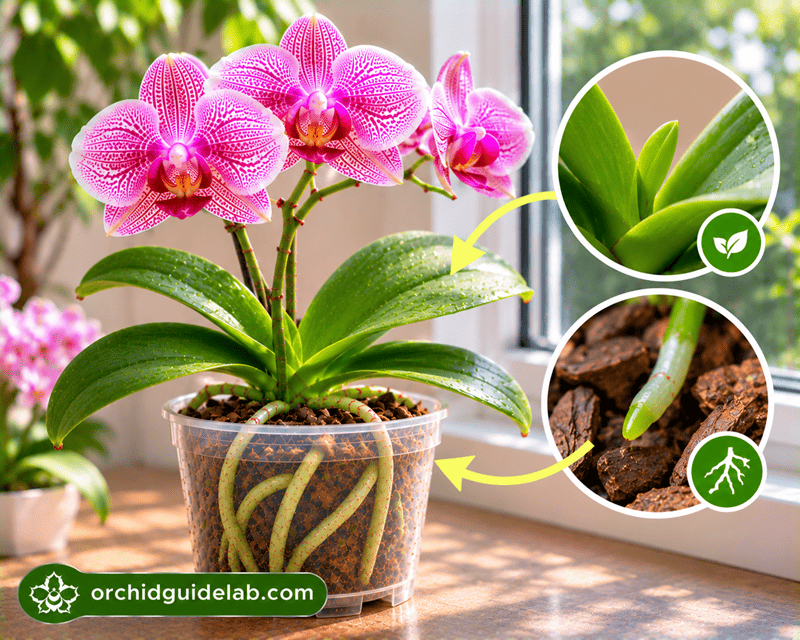
New root growth is one of the clearest signs that a Phalaenopsis orchid is entering an active growing period.
Fresh root tips often look smooth, firm and bright green. You may also notice a new leaf developing from the center of the plant.
Active growth is important because the orchid may begin using water and nutrients differently than it did during a slower winter period.
Do not force growth with excessive fertilizer or watering. Instead, support the growth the orchid is already producing.
SPRING LIGHT
Adjust orchids to stronger spring light
Spring sunlight gradually becomes stronger and lasts longer than winter sunlight.
A location that was suitable during winter may begin receiving more intense direct sun as the season progresses.
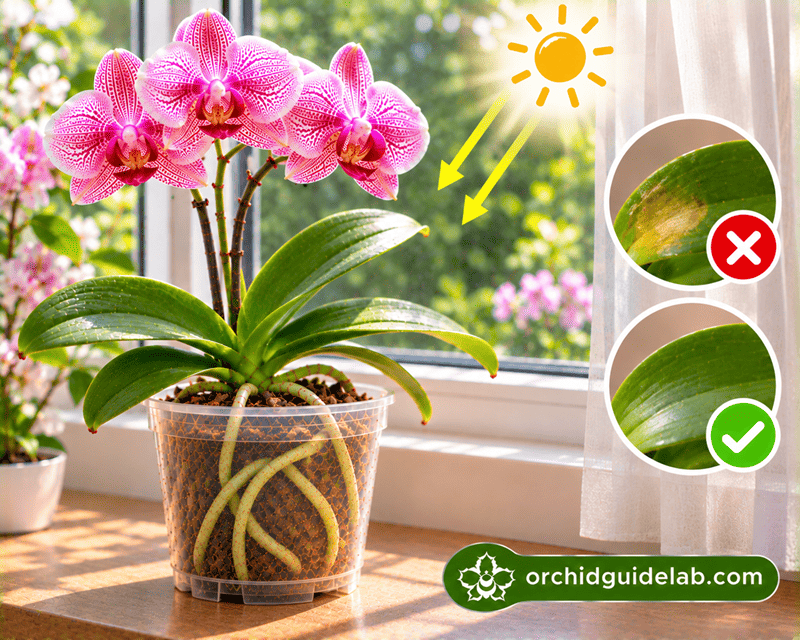
Phalaenopsis orchids generally prefer bright indirect light. Watch how sunlight reaches the leaves during different parts of the day.
If direct sunlight becomes intense, use a sheer curtain or move the orchid slightly farther from the window.
Make changes gradually. An orchid that has spent months in relatively weak winter light should not suddenly be exposed to hours of strong direct sun.
See How Much Light Do Orchids Need? and Best Window for Orchids for more information.
WATERING
Should you water orchids more often in spring?
Many orchids begin drying more quickly as spring brings warmer temperatures, longer days and active root growth.
However, this does not mean every orchid automatically needs a fixed increase in watering frequency.
Check the roots and potting medium before watering. In a clear pot, root color and visible moisture can provide useful clues about conditions inside the container.
Pot size, bark condition, sphagnum moss, humidity and airflow all influence how quickly an orchid dries.
Water thoroughly when moisture is needed and allow excess water to drain from the pot.
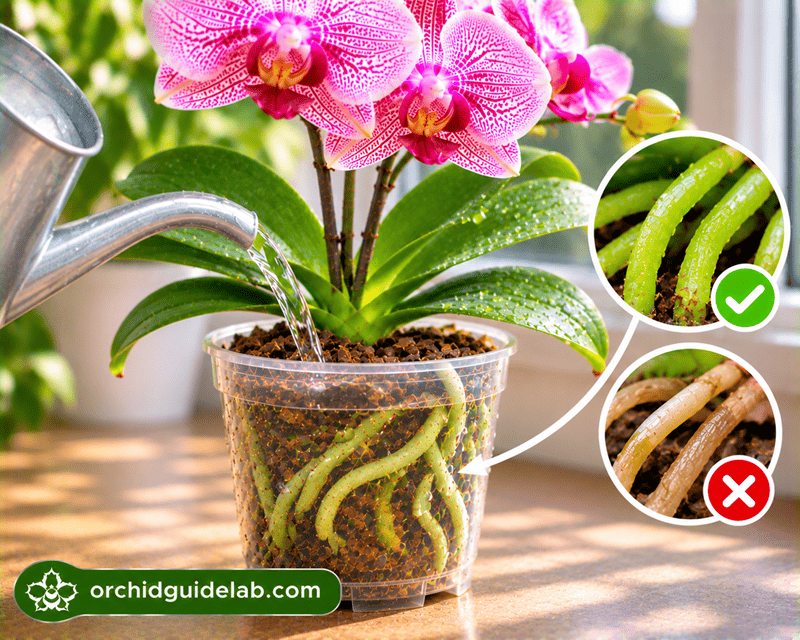
Do not switch to a rigid spring schedule. Check the orchid more frequently and let the plant's actual drying rate determine when you water.
Read How to Water Orchids Indoors and How to Tell When an Orchid Needs Water .
ROOT HEALTH
Check orchid roots carefully in spring
Spring is a good time to examine the condition of the orchid's root system, particularly if the plant is beginning to produce fresh root tips.
Healthy roots are generally firm. Their appearance can change depending on whether they are dry or recently watered.
Roots that are severely damaged, hollow or decomposing may indicate problems with the root environment or deteriorated potting medium.
New roots are especially valuable because they show that the plant is actively expanding its root system.
See Orchid Root Care for a detailed guide.
REPOTTING
Is spring a good time to repot an orchid?
Spring can be a useful time to repot a Phalaenopsis orchid, particularly when fresh roots are beginning to grow.
Active root growth can help the orchid establish itself in fresh potting medium after repotting.
However, spring itself is not a reason to repot a healthy orchid unnecessarily.
Repot when the bark or other medium has deteriorated, the root environment has become unsuitable, the pot no longer fits the plant properly or root problems require attention.
If the orchid is healthy and the potting medium is still in good condition, it may not need repotting at all.
Learn more in When to Repot an Orchid and How to Repot an Orchid .
POTTING MEDIUM
Inspect orchid bark and potting mix
While checking roots in spring, also examine the condition of the potting medium.
Fresh orchid bark should maintain spaces that allow air to move around the roots. As bark breaks down, it can become finer and more moisture-retentive.
Decomposed medium can change the balance between moisture and airflow inside the pot.
Do not replace good potting medium simply because it is spring, but use this seasonal inspection to identify deterioration before it becomes a root problem.
FERTILIZER
Fertilizing orchids in spring
When an orchid begins producing active roots and leaves, it may benefit from appropriate feeding.
Fertilizer should support healthy growth rather than force it. Use a suitable orchid fertilizer at an appropriate dilution and avoid assuming that a stronger solution will produce faster results.
Excess fertilizer can contribute to mineral accumulation in the potting medium and around sensitive roots.
If the orchid is not actively growing, do not dramatically increase feeding simply because spring has arrived.
The plant's growth should guide the decision.
Read How to Fertilize Orchids and When to Fertilize Orchids .
TEMPERATURE
Protect orchids from spring temperature swings
Spring weather can change quickly. Warm sunny afternoons may be followed by much cooler nights.
An orchid positioned near a window can experience these changes more strongly than a plant located farther inside the room.
Avoid leaving Phalaenopsis orchids next to very cold glass during chilly nights, and be cautious with open windows when outdoor temperatures are still low.
At the same time, increasingly strong sunlight can make a closed windowsill surprisingly warm during the day.
Aim for a reasonably stable indoor environment rather than exposing the orchid to abrupt extremes.
HUMIDITY & AIRFLOW
Balance spring humidity with airflow
Indoor humidity may change as heating systems are used less frequently and windows are opened more often.
Moderate humidity can support orchid growth, but stagnant air around wet leaves and roots is not desirable.
Maintain gentle air circulation around the plant without placing it directly in a strong draft.
If you begin opening windows in spring, make sure cool outdoor air is not blowing directly across a warm-growing orchid for long periods.
Read Humidity for Orchids for more information.
AFTER FLOWERING
What if your orchid finishes blooming in spring?
Some Phalaenopsis orchids finish a flowering cycle as spring growth begins.
Falling flowers do not mean the plant is unhealthy. After blooming, the orchid may redirect energy toward new leaves and roots.
Examine the flower spike before deciding what to do with it. A green spike and a completely dry brown spike are handled differently.
Continue normal root, light and watering care while the plant transitions from flowering to vegetative growth.
See Orchid Care After Blooming and What to Do With an Orchid Flower Spike After Blooming .
PLANT INSPECTION
Use spring growth as a reason to inspect the whole orchid
When checking new leaves and roots, take a moment to inspect the entire plant.
Look around the undersides of leaves, leaf joints, flower spikes, exposed roots and the surface of the potting medium.
Regular inspection makes it easier to notice unusual changes early instead of waiting until a problem becomes obvious.
Also clean accumulated dust from leaves when necessary so that you can observe their condition clearly.

QUICK CHECK
Spring orchid care checklist
Look for fresh roots and new leaves.
Adjust the orchid gradually to stronger spring light.
Check moisture more frequently as drying speeds increase.
Fertilize according to active growth.
Inspect bark, roots and pot condition.
Repot only when the orchid needs it.
Orchid Care for Beginners →COMMON MISTAKES
Common spring orchid care mistakes
- Suddenly watering much more often. Increase watering only when the orchid actually begins drying faster.
- Moving the orchid into strong direct sun. Spring sunlight becomes increasingly intense and can damage leaves.
- Overfertilizing new growth. Fresh roots and leaves need balanced care, not excessive fertilizer.
- Repotting every orchid automatically. Spring can be a convenient repotting period, but healthy orchids in good medium may not need it.
- Ignoring deteriorated bark. Old medium can retain more moisture and reduce airflow around roots.
- Exposing orchids to cold spring drafts. Open windows can create sudden temperature changes.
- Assuming every orchid grows on the same schedule. Individual plants respond differently to seasonal changes.
FINAL ADVICE
Let new growth guide your spring orchid care
Spring is a transition period when many indoor Phalaenopsis orchids move from slower winter conditions toward more active growth.
The most useful approach is to watch the plant itself. Fresh roots, new leaves, faster drying and changing light levels provide better guidance than a fixed seasonal schedule.
Increase watering only when the pot begins drying more quickly, provide bright indirect light and feed appropriately when active growth is visible.
Spring is also an excellent time to inspect roots, bark and pot condition and to repot when there is a genuine reason to do so.
With gradual adjustments and regular observation, spring can become one of the most productive periods in your orchid's annual growth cycle.
READ NEXT
More orchid care guides
How to Water Orchids Indoors
Learn how to water orchid roots without keeping them constantly wet.
How Much Light Do Orchids Need?
Give orchids enough light while protecting leaves from excessive sun.
When to Repot an Orchid
Recognize the signs that an orchid needs fresh medium or a new pot.
When to Fertilize Orchids
Match orchid feeding to active root and leaf growth.
Summer Orchid Care
Adjust watering, light and airflow for warmer summer conditions.
Winter Orchid Care
Adapt orchid care to shorter days, heating and cooler windows.