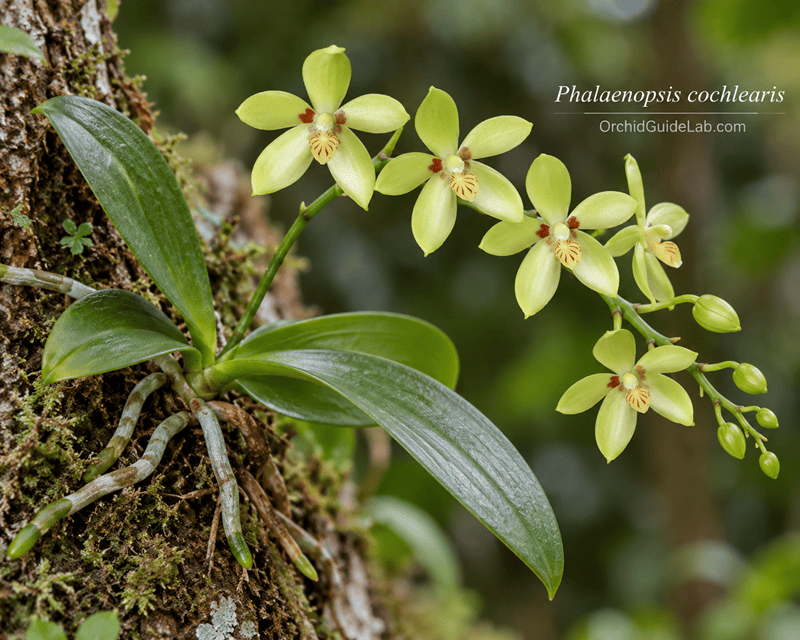
Description of Phalaenopsis cochlearis
Phalaenopsis cochlearis Holttum is an accepted botanical species in the family Orchidaceae. Kew's Plants of the World Online recognizes this name as accepted.
The species was described by British botanist Richard Eric Holttum and published in 1964 in the journal The Orchid Review .
Etymology
The specific epithet cochlearis comes from a Latin word associated with a spoon-shaped or concave form.
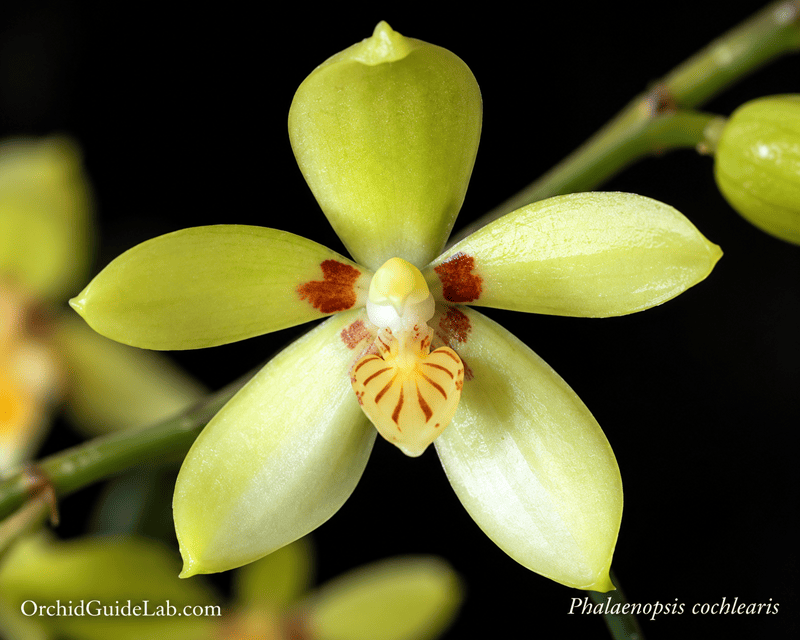
The name refers to the characteristic shape of the mid-lobe of the lip, one of the species' most distinctive morphological traits.
Natural range
According to current Plants of the World Online and World Flora Online data, the native range of Phalaenopsis cochlearis covers western Malesia.
The species is known from the Malay Peninsula, Borneo and Sumatra.
Phalaenopsis cochlearis grows mainly as an epiphyte in a wet tropical biome. Specialized orchid sources also describe populations in limestone areas at elevations of about 450–700 m.
Plant size
This is a relatively compact botanical Phalaenopsis, although its inflorescences can be much larger than the leaf rosette.
A mature plant usually produces only a few leaves, distinguishing it from many mass-market large-leaved hybrids.
Leaves
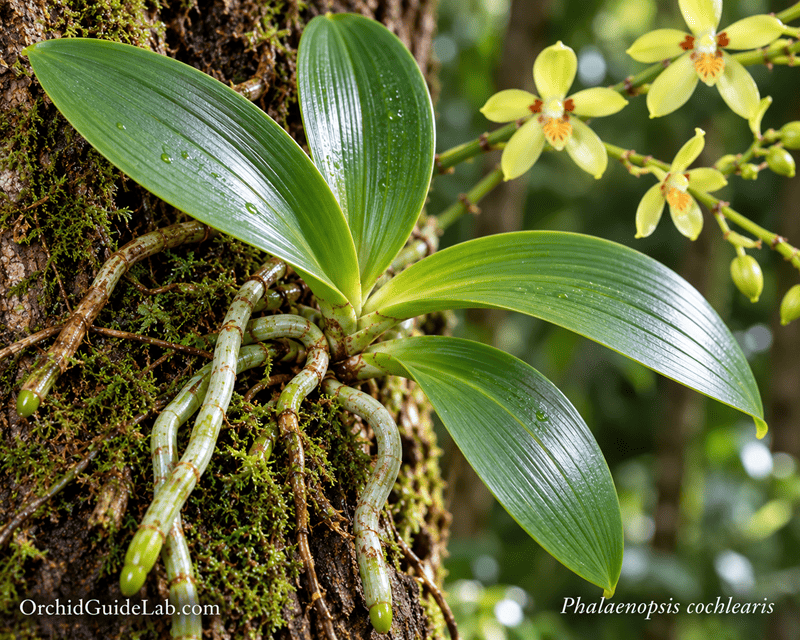
Phalaenopsis cochlearis typically has about 2–4 elongated leaves.
Their shape ranges from oblong-ovate to oblong-elliptic. The surface is green, with clearly visible venation.
Specialized descriptions report leaves up to about 20–22 cm long and up to 8 cm wide.
Important for identification: Phalaenopsis cochlearis should not have the very broad, rounded and numerous leaves typical of common mass-market hybrids. The species is characterized by a small number of elongated leaves with distinct venation.
Phalaenopsis cochlearis flowers
The flowers are about 4–5 cm across and usually have a light, open appearance.
The base color may be pale yellow, yellow-green, light green or creamy yellow.
Brown, ochre-brown or brownish-orange markings may occur near the base of the petals and around the center.
Flower shape
The flower of Phalaenopsis cochlearis is noticeably different from the large rounded blooms of commercial Phalaenopsis.
The sepals and petals are relatively narrow, giving the flower a more open, botanical outline.
The most characteristic part of the flower is the lip with a distinctly concave mid-lobe. This feature is reflected in the species name.
Inflorescence
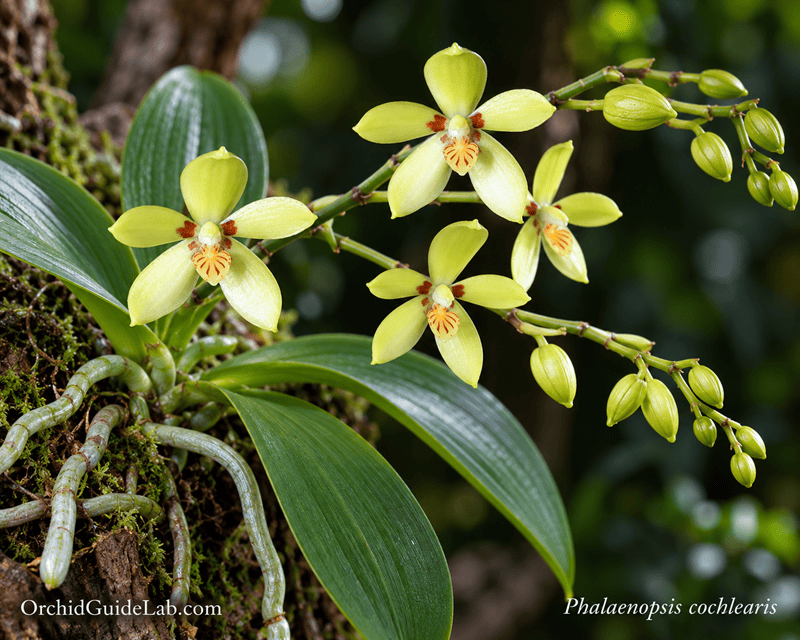
The inflorescence is long, mostly suberect and often branched.
Specialized botanical descriptions report a length of approximately 30–50 cm.
The main axis may remain more upright while the lateral branches gradually arch or hang somewhat downward.
The branches carry from a few to many flowers, giving a mature plant a light, branched silhouette in bloom.
Flowering period
Specialized orchid sources often describe Phalaenopsis cochlearis as flowering during the warmer part of the year.
In cultivation, exact timing depends on temperature, light, plant maturity and growing conditions, so the flowering calendar should not be treated as completely fixed.
Phalaenopsis cochlearis photos
Click a photo to open a larger view.

Phalaenopsis cochlearis video
Watch Phalaenopsis cochlearis in this short video: pale yellow-green flowers with localized reddish-brown markings near the center, the characteristic spoon-shaped lip, branched inflorescence, leaves, roots and the overall appearance of the plant.
Synonymy
Plants of the World Online and World Flora Online list one homotypic synonym for this species:
Polychilos cochlearis (Holttum) Shim , published in 1982.
The currently accepted name is Phalaenopsis cochlearis Holttum .
Phalaenopsis cochlearis and similar species
Correct identification of Phalaenopsis cochlearis requires more than simply judging the overall flower color.
Look for the combination of a small number of elongated leaves, a long branched inflorescence, pale yellowish flowers with brown markings, and especially the characteristic concave lip.
For photos: Phalaenopsis cochlearis should not be depicted like a large-flowered mass-market Phalaenopsis. The flower should remain more open and botanical, with narrower segments and a clearly visible spoon-shaped lip.
Phalaenopsis cochlearis care
The species comes from wet tropical conditions, so cultivation should provide warmth, moderately high humidity and stable conditions.
At the same time, the epiphytic roots need adequate airflow. A constantly wet, compacted substrate increases the risk of root problems.
Pot and substrate
For home cultivation, a transparent ventilated pot can be used to monitor root condition.
The substrate should be loose and airy. Appropriately sized high-quality orchid bark can form the base.
The pot should not be much larger than the root system, because a large volume of wet substrate dries more slowly.
Watering
Phalaenopsis cochlearis comes from a wet tropical biome, so prolonged complete drying of the roots is undesirable.
At the same time, the substrate should lose excess moisture between waterings and the roots should receive adequate airflow.
Practical tip: do not rely only on a watering calendar; consider root condition, pot weight, temperature, ventilation and how quickly the bark dries.
Light
Bright filtered light is suitable without prolonged exposure to harsh midday sun.
In nature, the plant grows under tropical vegetation, so overheating the leaves with direct sun is undesirable.
Temperature
Specialized sources describe Phalaenopsis cochlearis as a warm- to intermediate-warm-growing species.
Stability is important in home cultivation: protect the plant from sudden cold drafts and major temperature stress.
Humidity and ventilation
Higher air humidity should be combined with gentle, continuous air circulation.
Do not leave water sitting for long periods in the center of the rosette or between the leaf bases, especially under cool conditions.
What makes Phalaenopsis cochlearis special
The species' main ornamental and botanical feature is the unusual combination of pale yellow-green flowers, a branched inflorescence and a distinctive lip shape.
The lip is what makes Phalaenopsis cochlearis especially recognizable among many other botanical Phalaenopsis.
Sources
The accepted name, authorship, publication year, native range, growth habit and synonymy were checked against Kew, IPNI and World Flora Online. Flower, leaf and inflorescence morphology was compared with specialized orchid sources.