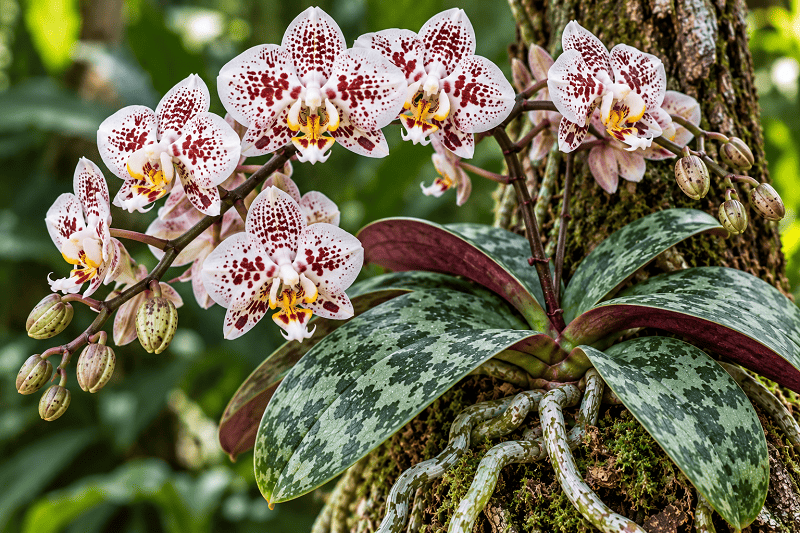
Description of Phalaenopsis stuartiana
Phalaenopsis stuartiana Rchb.f. belongs to the family Orchidaceae. Plants of the World Online recognizes this name as accepted for a distinct botanical species.
The species was published in 1881. In nature, Phalaenopsis stuartiana grows primarily as an epiphyte in wet tropical habitats.
Natural range
According to Kew, the native range of Phalaenopsis stuartiana is the Philippines, particularly the island of Mindanao.
Its epiphytic growth habit means that the plant uses trees for support, while its roots are adapted to an open, well-aerated environment.
Important: in home cultivation, this species should not be kept in a dense substrate that stays wet for long periods and restricts airflow to the roots.
Phalaenopsis stuartiana leaves
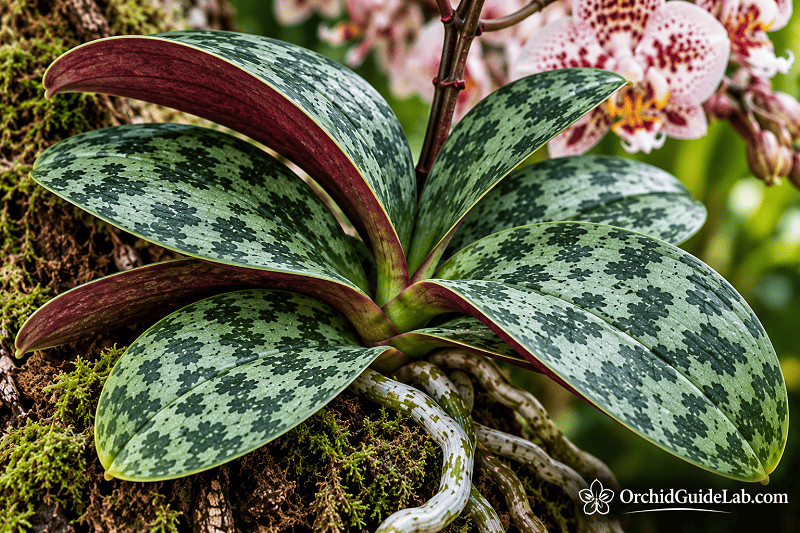
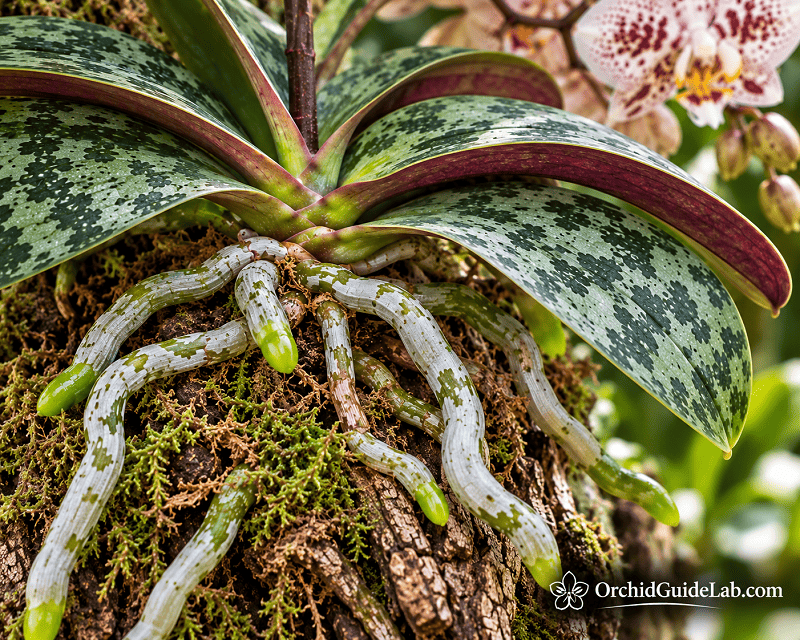
One of the species' most noticeable ornamental features is its broad, fleshy foliage with a characteristic gray-green mottled or marbled pattern.
According to the Royal Horticultural Society, the leaves may reach about 35 cm in length. The undersides of the leaves have a purple coloration.
Roots
Like other epiphytic Phalaenopsis, Phalaenopsis stuartiana produces thick roots, some of which may grow above the surface of the substrate.
Aerial roots are a normal part of the plant's structure. Healthy roots should not be cut off simply because they grow outside the pot.
Phalaenopsis stuartiana flowers
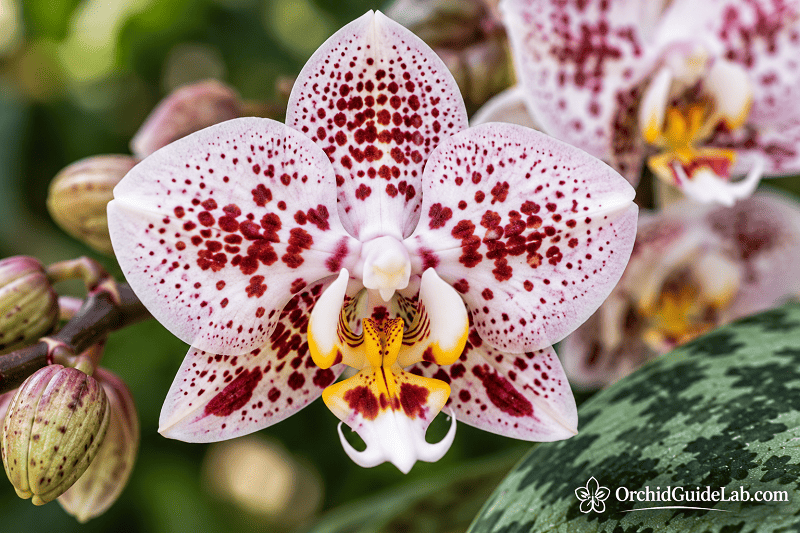
The flowers are mainly pale or white, with characteristic yellow details and reddish-brown spots on the lower sepals and the lip.
According to the RHS, an individual flower may be around 8 cm across.
Flower spikes and blooming
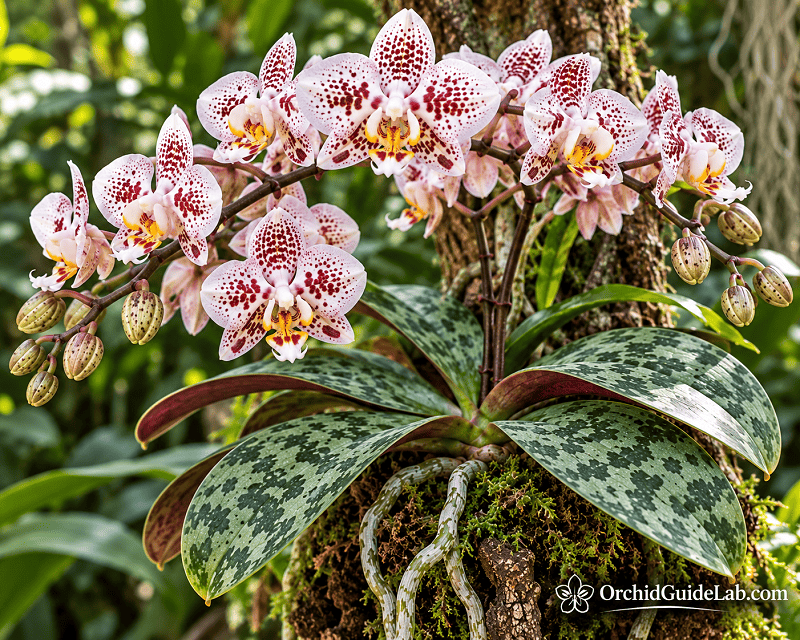
Phalaenopsis stuartiana can produce long, branched flower spikes. The RHS gives an inflorescence length of up to about one meter.
On very well-developed mature plants grown under favorable conditions, the number of flowers can be considerable. This is the potential of large mature specimens, however, rather than a guaranteed flower count for every plant grown at home.
Phalaenopsis stuartiana photos
Click a photo to open a larger view.
Phalaenopsis stuartiana video
Watch Phalaenopsis stuartiana in this short video: its characteristic pale flowers with reddish-brown markings, mottled leaves, aerial roots and overall plant appearance.
Phalaenopsis stuartiana and Phalaenopsis schilleriana
Phalaenopsis stuartiana and Phalaenopsis schilleriana are currently recognized as separate botanical species.
The historical name Phalaenopsis schilleriana var. stuartiana was used in the past, but Kew now places it in the synonymy of Phalaenopsis stuartiana.
Synonyms
Kew lists several historical names that are now included in the synonymy of Phalaenopsis stuartiana.
Phalaenopsis stuartiana care
Bright, filtered light without strong direct midday sun is suitable for this species.
The RHS recommends growing Phalaenopsis stuartiana in an open bark-based substrate or mounted, provided suitable humidity can be maintained.
Water when the substrate is approaching dryness. Root condition, pot weight and bark moisture are more useful indicators than a rigid watering schedule.
Practical tip: pale silvery roots can be one sign that watering is approaching, but always check the moisture level deeper inside the pot as well.
Temperature
As a cultivation guideline, the RHS gives around 17 °C at night and 20–25 °C during the day.
Avoid cold drafts, sudden chilling and prolonged overheating of the plant.
Substrate
Dense universal potting soil is not suitable for this epiphytic species. The root system needs good access to air.
An open orchid bark mix and a pot with good drainage make it much easier to manage moisture around the roots.
What makes Phalaenopsis stuartiana special
This species remains ornamental even when it is not in bloom because of its mottled foliage.
During flowering, the combination of long branched spikes, white flowers and characteristic yellow and reddish-brown markings makes Phalaenopsis stuartiana easy to recognize among many other members of the genus.
Sources
Taxonomic status, authorship, publication date, natural range, growth habit and synonymy were checked against Kew. Leaf and flower descriptions and basic cultivation guidance were compared with the Royal Horticultural Society.