
Description of Phalaenopsis aphrodite
Phalaenopsis aphrodite Rchb.f. belongs to the family Orchidaceae. Plants of the World Online recognizes this name as accepted for a distinct botanical species.
The name was published by Heinrich Gustav Reichenbach in 1862. The species is one of the classic white-flowered members of the genus Phalaenopsis.
Native range
According to the current Kew taxonomic database, the native range of Phalaenopsis aphrodite is the Philippines.
The plant is an epiphyte and grows mainly in wet tropical habitats. Its roots naturally receive abundant airflow and do not grow in dense soil.
Taxonomic note: older literature often included southeastern Taiwan within the range of Phalaenopsis aphrodite. Current Kew taxonomy recognizes the Taiwanese plants as a separate species Phalaenopsis formosana , so the current native range given for Phalaenopsis aphrodite is the Philippines.
Leaves
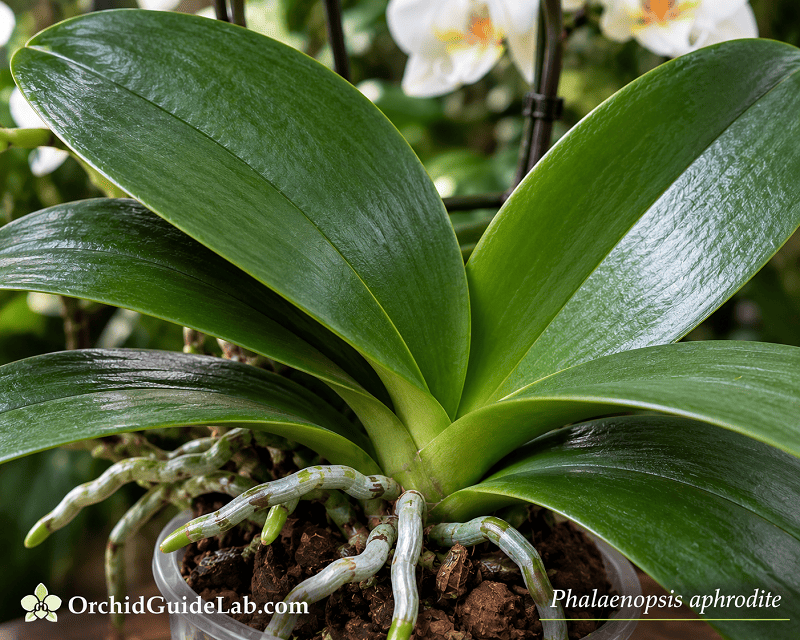
Phalaenopsis aphrodite has a monopodial growth habit. Its leaves are fleshy, broad, oval to elliptic, and arranged around a short central stem.
Like other Phalaenopsis, this species does not form pseudobulbs. The plant stores part of its water reserves in its succulent leaves and fleshy root system.
Phalaenopsis aphrodite flowers
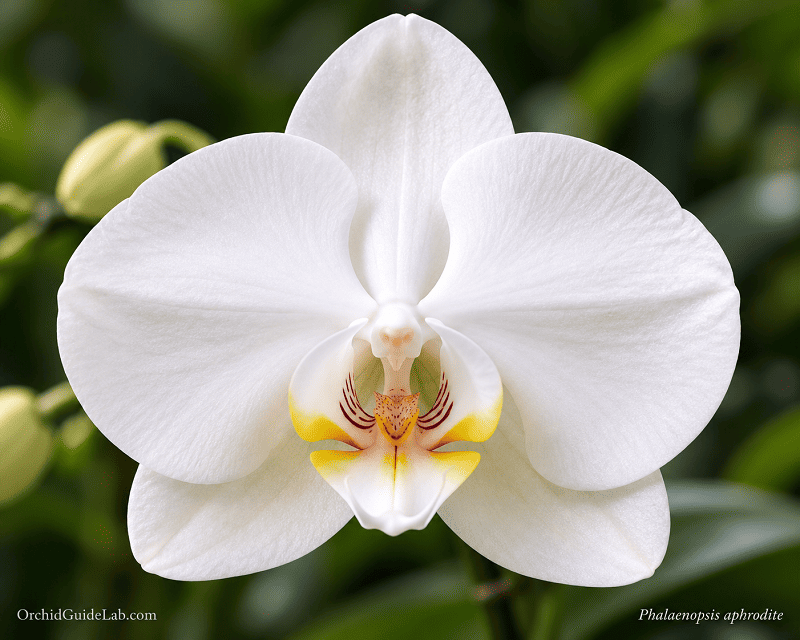
The flowers are mainly pure white to milky white, broad and rounded in overall outline. The center of the flower has yellow and reddish to reddish-brown details.
The American Orchid Society notes that the flowers of Phalaenopsis aphrodite resemble those of Phalaenopsis amabilis but are usually somewhat smaller and may appear fuller because of their broad perianth segments.
Flower lip
The lip is an important feature when comparing closely related white-flowered Phalaenopsis species.
Phalaenopsis aphrodite typically has yellow and red details in the center, while the structure of the middle lobe of the lip helps distinguish it from Phalaenopsis amabilis.
Flower spike and blooming
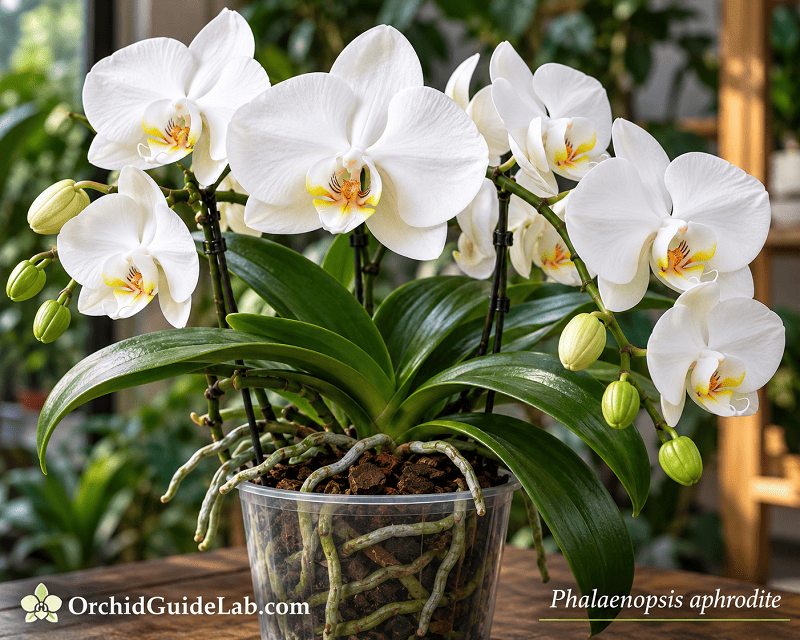
A mature plant can produce long arching or branched flower spikes with many buds.
The flowers open gradually, forming a striking pale inflorescence. Bloom duration and abundance depend on plant age, light, temperature, root condition and overall growing conditions.
Roots
As an epiphytic orchid, Phalaenopsis aphrodite produces thick roots covered with velamen.
Some roots may grow above the substrate or extend outside the pot. This is a natural feature, so healthy aerial roots should not be cut off simply because of where they grow.
Phalaenopsis aphrodite photos
Click a photo to open a larger view.

Phalaenopsis aphrodite video
Watch Phalaenopsis aphrodite in this short video: its characteristic white flowers, leaves, aerial roots and overall plant appearance.
Phalaenopsis aphrodite and Phalaenopsis amabilis
These two white-flowered species were confused for a long time. In botanical literature, Phalaenopsis aphrodite was often treated as a form or variety of Phalaenopsis amabilis.
Today, Kew recognizes Phalaenopsis aphrodite and Phalaenopsis amabilis as separate accepted species.
The American Orchid Society also notes differences in size, flower fullness and lip structure. Reliable identification is best based on several traits rather than white coloration alone.
Phalaenopsis aphrodite and Phalaenopsis formosana
In older sources, Taiwanese populations could be referred to as Phalaenopsis aphrodite subsp. formosana .
Current Kew taxonomy recognizes Phalaenopsis formosana as a separate accepted species native to southeastern Taiwan and adjacent islands.
Synonyms
During its botanical history, Phalaenopsis aphrodite has appeared under several names. Kew currently recognizes Phalaenopsis aphrodite Rchb.f. as the accepted name.
Natural hybrid Phalaenopsis × intermedia
Kew recognizes the natural hybrid Phalaenopsis × intermedia , which occurs naturally in the Philippines.
Its parentage is: Phalaenopsis aphrodite × Phalaenopsis equestris .
It is a separate natural hybrid, not a synonym of Phalaenopsis aphrodite.
Phalaenopsis aphrodite care
Bright, filtered light is suitable for home cultivation. Strong direct midday sun through window glass is best avoided to prevent overheating the leaves.
Like other warm-growing Phalaenopsis, Phalaenopsis aphrodite does best in consistently warm conditions without cold drafts.
For Phalaenopsis generally, the RHS recommends bright light without strong direct sun and temperatures above about 16 °C.
Watering
Water according to the actual condition of the substrate and root system rather than following an unchanging calendar.
The roots should not remain constantly waterlogged and airless. At the same time, an actively growing plant should not be subjected to excessive prolonged drying.
Practical tip: a transparent pot makes it easier to monitor root condition and bark moisture. Before watering, check not only the surface but also the middle of the substrate.
Substrate and pot
Epiphytic Phalaenopsis aphrodite needs an airy substrate. In home cultivation, a bark-based orchid mix is commonly used.
Dense ordinary houseplant soil holds too much water and restricts airflow to the root system.
Humidity and air movement
Origin in a wet tropical biome does not mean the plant should remain in stagnant wet conditions.
At higher humidity, moderate air movement around the leaves, roots and substrate is especially important.
Importance in Phalaenopsis breeding
Phalaenopsis aphrodite belongs to a group of white-flowered species that played an important role in the ancestry of many modern white and pink Phalaenopsis hybrids.
The American Orchid Society places it with Phalaenopsis amabilis, Phalaenopsis schilleriana and Phalaenopsis sanderiana in a closely related group important to the breeding history of the genus.
What makes Phalaenopsis aphrodite special
The species combines large pale flowers, the classic Phalaenopsis form and important historical significance in orchid cultivation.
It is especially important in a botanical Phalaenopsis catalog because it helps explain the ancestry of many modern white-flowered hybrids.
Sources
Taxonomic status, authorship, publication date, current native range and synonymy were checked against Kew. Information on the species' history, morphological differences and role in breeding was compared with the American Orchid Society. General principles for growing Phalaenopsis at home were checked against the RHS.