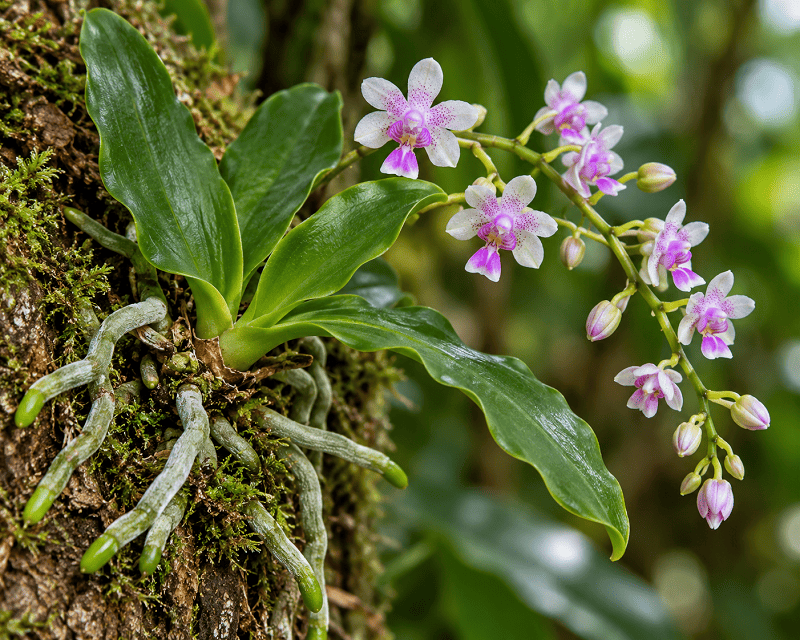
Description of Phalaenopsis deliciosa
Phalaenopsis deliciosa Rchb.f. is an accepted botanical species in the orchid family Orchidaceae.
The name was published by Heinrich Gustav Reichenbach in 1854 in Bonplandia.
This is one of the smallest members of the genus Phalaenopsis, so a mature flowering plant looks very different from the large-flowered hybrids commonly sold as houseplants.
Natural range
Phalaenopsis deliciosa has an unusually broad natural distribution.
Kew records the species across the Indian subcontinent, the Himalayas, Bangladesh, Nepal, Sri Lanka, Myanmar, Thailand, Laos, Cambodia, Vietnam, southern China, Malaya, Borneo, Java, Sumatra, Sulawesi, the Moluccas and the Philippines.
It occurs as an epiphyte or lithophyte and is primarily associated with wet tropical habitats.
Natural habitat
Specialist orchid references describe Phalaenopsis deliciosa mainly from lowland tropical habitats, generally below about 600 m elevation.
It may grow in riverine forest and other humid tropical environments, attaching its roots to tree bark or rocky surfaces.
Plant size
Phalaenopsis deliciosa is a true miniature Phalaenopsis.
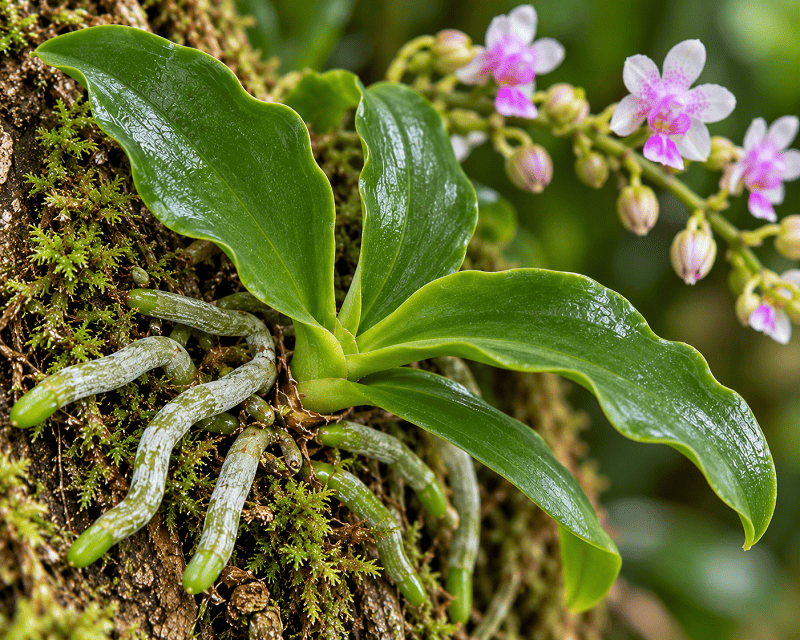
The stem is very short, and the compact rosette carries only a few leaves.
This small scale is important when identifying or photographing the species: neither the leaves nor the flowers should resemble those of a large commercial hybrid.
Leaves
World Flora Online describes the plant as usually carrying three or four leaves that remain present during flowering.
The leaf blade is oblanceolate to elliptic, approximately 8–14.5 cm long and 3–5.5 cm wide.
The leaf margins may be noticeably undulate, while the tip can be pointed and slightly curved.
Important for identification: Phalaenopsis deliciosa is a miniature species. It should not be represented with large, rounded flowers or massive foliage typical of modern commercial Phalaenopsis hybrids.
Flowers of Phalaenopsis deliciosa
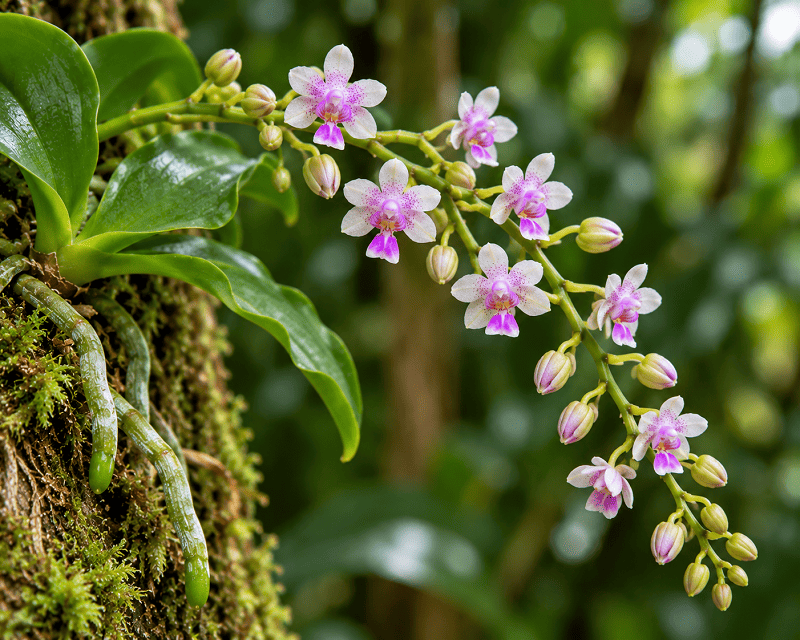
The flowers are very small, usually around 1.5–2 cm across.
World Flora Online describes them as whitish with pale violet stripes or markings.
The floral segments appear light and delicate rather than broad, heavy or strongly overlapping.
Flower shape
The dorsal sepal is subelliptic.
The lateral sepals are somewhat obliquely ovate, while the petals are small and obovate.
Because of their small size, the flowers look delicate and airy on the slender inflorescence.
Flower color
A typical flower has a whitish or very pale background.
The sepals and petals may carry soft violet, pink-violet or purple markings.
The intensity of the pattern can vary between individual plants.
Lip
The lip is three-lobed and structurally complex despite the flower's very small size.
The lateral lobes are directed upward, while the midlobe extends more horizontally.
Near the base there is a small spur-like structure, and the midlobe carries characteristic thickenings and projections.
Inflorescence
The inflorescence is slender and often pendulous.
World Flora Online gives a length of approximately 10–15 cm, with the upper part sometimes branching.
IOSPE reports inflorescences reaching about 20 cm.
A single spike can carry many very small flowers.
Sequential blooming
One of the useful features of Phalaenopsis deliciosa is its prolonged sequential blooming.
The buds do not all open at once. New flowers may appear one after another over an extended period.
Under good growing conditions, the plant may bloom more than once during the year.
Practical tip: do not remove a healthy green flower spike too quickly. Because this species can bloom sequentially, the same living inflorescence may continue producing flowers.
Phalaenopsis deliciosa photos
Click a photo to open a larger view.

Phalaenopsis deliciosa video
Watch Phalaenopsis deliciosa in bloom: tiny pale flowers with violet markings, the slender arching inflorescence, compact leaves, roots and the overall structure of this miniature species.
Synonyms
Plants of the World Online lists a substantial number of historical synonyms for Phalaenopsis deliciosa.
Homotypic synonyms include Doritis deliciosa (Rchb.f.) T.Yukawa & K.Kita and Kingidium deliciosum (Rchb.f.) H.R.Sweet .
In older orchid literature, the species may also appear under names associated with the genera Kingidium, Doritis and Kingiella.
The accepted modern name is Phalaenopsis deliciosa Rchb.f. .
Phalaenopsis deliciosa and the old name Kingidium
Because of its miniature size, flower structure and overall habit, this species was historically separated from more typical Phalaenopsis.
This is why the name Kingidium deliciosum can still be found in older references and orchid collections.
In the current Kew treatment, the accepted name remains Phalaenopsis deliciosa .
Phalaenopsis deliciosa care
Its origin in humid tropical habitats and its small plant size shape the main requirements in cultivation.
The species benefits from warmth, good air movement, filtered light and an even moisture regime without keeping the roots constantly wet.
Pot and substrate
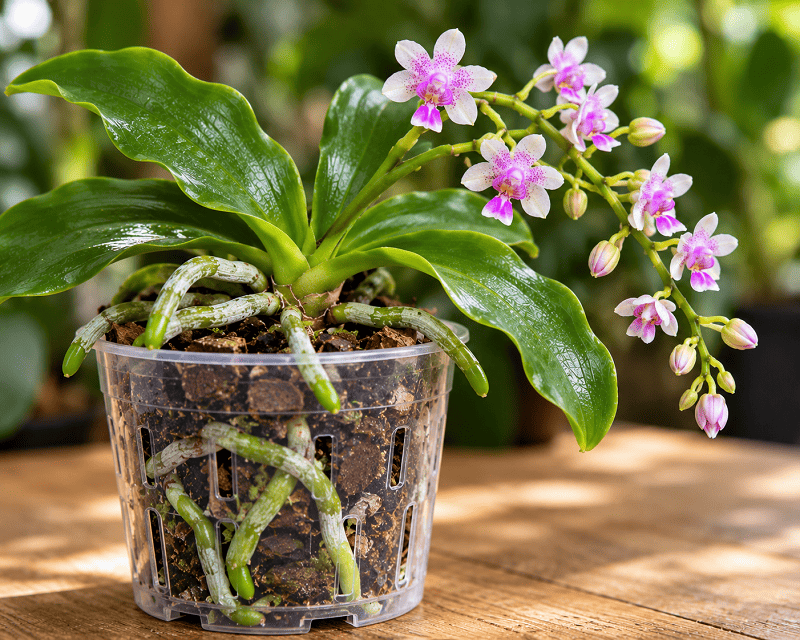
Because Phalaenopsis deliciosa stays compact, it does not need a large pot.
A small transparent ventilated pot is useful because it makes it easier to monitor the roots.
The substrate should drain quickly while leaving plenty of air around the root system.
Watering
During active growth, avoid prolonged severe drying.
At the same time, the compact root system is vulnerable to a constantly wet, compacted substrate.
The next watering should be based on the condition of the roots, the substrate, temperature and how quickly the pot dries.
Practical tip: a small pot dries differently from a large one. Check the roots and substrate directly instead of watering only by a fixed schedule.
Light
Phalaenopsis deliciosa grows well in bright, filtered light.
Prolonged harsh midday sun is best avoided, especially because this species has relatively compact, thinner foliage.
Temperature
IOSPE characterizes Phalaenopsis deliciosa as a warm to hot-growing orchid.
In home cultivation, stable warmth is preferable to sharp cold fluctuations.
Humidity and air movement
Humid air matches the species' natural tropical origin, but higher humidity should always be paired with good air circulation.
Avoid keeping the substrate constantly wet or allowing water to remain trapped in the crown for long periods.
What makes Phalaenopsis deliciosa special
The species is valued for its genuinely miniature growth, numerous delicate flowers and prolonged sequential blooming.
Phalaenopsis deliciosa is a good example of how diverse wild Phalaenopsis species can be compared with large modern hybrids.
Sources
The accepted name, authorship, publication, natural range, growth habit and synonymy were checked against Kew and World Flora Online. Leaf, flower and inflorescence morphology were cross-checked with WFO, IOSPE and the American Orchid Society.